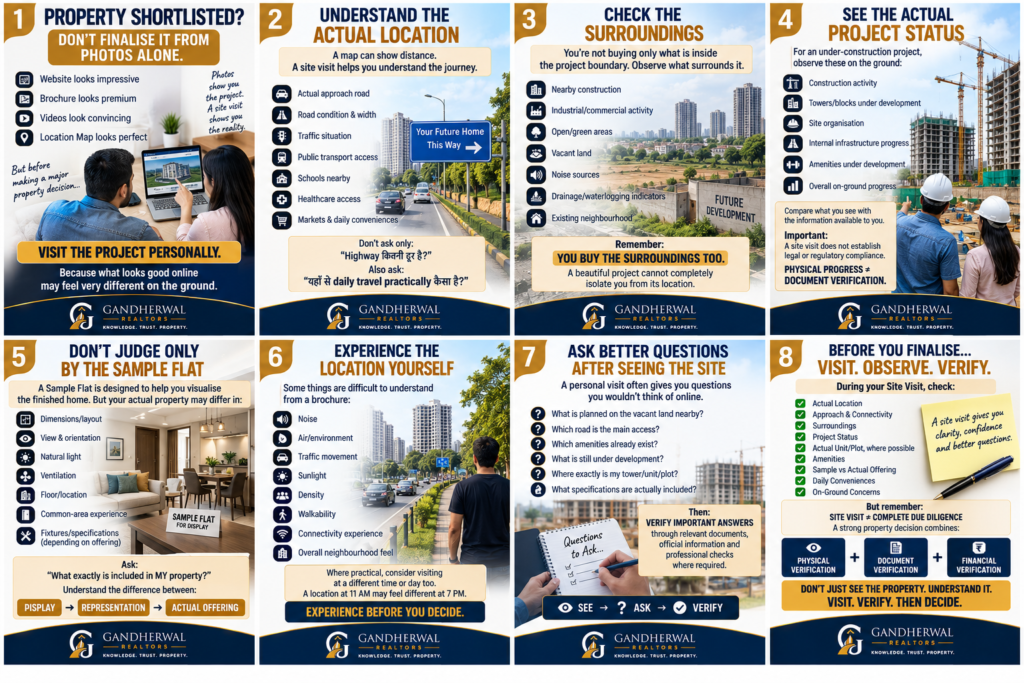

Buying a property often begins online.
You see attractive photographs, watch a project video, download a brochure, study the location map and perhaps even take a virtual tour.
Everything may look impressive.
The project appears well connected. The sample flat looks spacious. The amenities seem attractive. The location map suggests that schools, hospitals, markets and major roads are nearby.
But before making a major financial commitment, there is one step that should not be overlooked:
Visit the Project Personally
A property is not just a flat, floor, villa or plot.
You are also buying into its location, accessibility, surroundings, infrastructure and everyday living environment.
A personal site visit can help you understand aspects of a property that photographs, brochures and online listings may not fully communicate.
However, a site visit should also not be mistaken for complete due diligence.
The better approach is:
VISIT → OBSERVE → ASK → VERIFY → THEN DECIDE
Let’s understand why.
1. A Location Map Shows Distance—A Site Visit Shows the Journey
A project brochure may say:
- 10 minutes from a highway
- 15 minutes from a school
- Close to a hospital
- Well connected to major roads
- Near an upcoming infrastructure project
Such information can be useful, but distance on a map does not always tell you what the actual journey is like.
During your site visit, observe:
- Main approach road
- Road width
- Road condition
- Entry and exit points
- Traffic
- Public transport availability
- Last-mile connectivity
- Nearby markets
- Schools
- Hospitals
- Daily conveniences
For example, a project may appear only a few kilometres from a major highway.
But ask:
How practical is the route connecting the project to that highway?
A short distance with poor access may feel very different from a slightly longer distance with smooth connectivity.
Therefore, don’t ask only:
“Highway कितनी दूर है?”
Also ask:
“यहाँ से daily travel practically कैसा है?”
2. You Are Buying the Surroundings Too
A beautiful residential project does not exist in isolation.
What lies outside the project boundary can have a significant impact on your everyday experience.
During your visit, observe the surrounding area carefully.
Look for:
- Existing residential development
- Nearby construction
- Commercial activity
- Industrial activity, if any
- Open or green areas
- Vacant land
- High-traffic roads
- Noise sources
- Drainage conditions
- Waterlogging indicators
- Nearby utilities or infrastructure
- General neighbourhood condition
A brochure will naturally focus on the project.
As a buyer, your responsibility is to understand the larger environment around it.
Remember:
YOU BUY THE SURROUNDINGS TOO.
3. See the Actual Project Status
If you are considering an under-construction property, a personal visit allows you to observe what is actually happening on the ground.
You may be able to see:
- Construction activity
- Towers or blocks under development
- Internal roads
- Site organisation
- Landscaping progress
- Amenities under construction
- Entry infrastructure
- Common areas
- Overall development progress
Compare what you observe with the information available to you.
But this distinction is extremely important:
PHYSICAL PROGRESS ≠ DOCUMENT VERIFICATION
Seeing active construction does not by itself establish that every required approval is in place or that every representation made about the project is correct.
Similarly, a visually impressive site should not replace regulatory, legal and document-related verification.
Use the site visit to understand physical reality.
Use relevant documents and official sources to understand the documented/regulatory position.
4. Don’t Evaluate the Property Only Through the Sample Flat
Sample flats can be useful.
They help buyers visualise:
- Room arrangement
- Furniture placement
- Interior possibilities
- Overall look and feel
But remember:
A Sample Flat Is a Presentation Tool
Your actual property may differ in important ways.
Depending on the project and offering, consider:
- Actual dimensions
- Layout
- Ceiling height
- View
- Orientation
- Natural light
- Ventilation
- Floor
- Tower/location
- Common areas
- Fixtures
- Specifications
- Finishing
- Balcony/open-space experience
Furniture and interior design can also influence how large or attractive a space appears.
Therefore, ask clearly:
“What exactly is included in MY property?”
Where possible, understand the difference between:
DISPLAY → REPRESENTATION → ACTUAL OFFERING
Don’t assume that everything visible in the sample flat necessarily forms part of the property being sold.
Check the applicable specifications and documents.
5. Understand the Actual Unit, Tower or Plot Location
Even within the same project, two properties can offer different experiences.
For an apartment, consider factors such as:
- Tower location
- Floor
- Orientation
- View
- Distance from entry/exit
- Proximity to amenities
- Nearby roads
- Adjacent towers
- Open areas
For a plot, consider:
- Exact location within the layout
- Dimensions
- Orientation
- Approach
- Nearby roads
- Adjacent plots
- Surrounding development
For a builder floor or villa, other property-specific factors may apply.
Therefore, don’t evaluate only:
“Project कैसा है?”
Also evaluate:
“जिस specific property को मैं खरीद रहा हूँ, उसकी location कैसी है?”
6. Check Existing Amenities vs Proposed Amenities
Swimming pool.
Clubhouse.
Gym.
Sports facilities.
Landscaped gardens.
Children’s play area.
These features can make a project attractive.
But during your visit, determine:
What exists today?
What is currently under development?
What is proposed or expected later?
This distinction can be especially relevant in an under-construction or developing project.
If a particular amenity is important to your purchase decision, understand the applicable project information and documentation relating to it rather than relying only on a visual representation or verbal statement.
7. Experience What a Brochure Cannot Show
Some aspects of a location are difficult to understand from photographs.
For example:
Noise
Is there significant traffic, construction or commercial activity nearby?
Traffic
What happens during peak hours?
Density
Does the project or surrounding neighbourhood feel more crowded than expected?
Walkability
Can you conveniently reach nearby daily-use facilities?
Sunlight and Ventilation
Where an actual unit can be inspected, what is the real experience?
General Environment
How does the neighbourhood actually feel?
These factors may be subjective—but that makes personal observation even more important.
A location suitable for one buyer may not suit another.
8. Consider Visiting at a Different Time
If the property is a serious contender and practical circumstances allow, consider visiting the location more than once or at a different time.
Why?
Because:
A location at 11 AM may feel different at 7 PM.
A quiet road during the afternoon may become congested during office hours.
An area that seems well connected on Sunday may have a very different weekday commute.
Similarly, evening activity, lighting, accessibility and neighbourhood movement can provide additional context.
You don’t necessarily need numerous visits to every property you shortlist.
But for a property you are seriously considering, another visit can sometimes answer questions that the first one did not.
9. Don’t Depend Only on the Route Shown by the Sales Team
When visiting a project, you may naturally be guided through a particular route.
If practical, explore the surrounding area yourself as well.
Check:
- Alternative access roads
- Nearby sectors/localities
- Local markets
- Public transport points
- Schools and hospitals
- Existing neighbourhoods
- Major connecting roads
This can help you understand the location beyond the immediate sales experience.
The goal is not to search for faults.
The goal is to build a complete picture.
10. Look Beyond the Project Gate
A common site-visit mistake is:
Enter project → See sample flat → Discuss price → Leave.
Instead, allocate some time to the neighbourhood.
Drive or walk around the surrounding area where practical.
A project may have an attractive internal environment, but your daily life will also involve:
- Commuting
- Shopping
- School travel
- Healthcare
- Deliveries
- Visitors
- Public infrastructure
- Surrounding development
Your evaluation should therefore extend beyond the project’s entrance.
11. A Site Visit Helps You Ask Better Questions
One of the biggest benefits of physically visiting a project is that you begin to notice things that generate better questions.
You may see vacant land beside the project and ask:
“What is planned here?”
You may notice another access road and ask:
“Which road is the project’s main access?”
You may see an incomplete clubhouse and ask:
“Which amenities are operational and which are still under development?”
You may inspect a sample flat and ask:
“Which of these specifications are actually included?”
You may see several towers and ask:
“Where exactly is my proposed unit?”
This creates a valuable process:
SEE → ASK → VERIFY
12. Don’t Stop at the Salesperson’s Answer
Asking questions is important.
But for important matters, verification is equally important.
Suppose you are told:
“A new road is coming here.”
The next question should be:
What is the current status of that road?
Is it:
- Existing?
- Under construction?
- Officially approved?
- Announced/proposed?
- Merely expected?
Similarly, if you are told that a particular amenity, specification or project feature will be provided, understand how that representation is reflected in the relevant official/project documentation where applicable.
A Useful Rule:
IMPORTANT CLAIM → ASK → VERIFY
13. Talk to Existing Residents Where Possible
For completed or partly occupied developments, conversations with existing residents can sometimes provide useful practical context.
You may ask general questions about:
- Daily connectivity
- Maintenance
- Water/electricity experience
- Common areas
- Amenities
- Traffic
- Neighbourhood
- Day-to-day living
Resident feedback should not automatically be treated as verified fact—different residents can have different experiences.
But it can help identify issues or questions worth investigating further.
Use such conversations as an additional information source, not a substitute for your own verification.
14. Take Notes, Photos and Videos Where Permitted
If the project permits photography/video, maintaining a simple site-visit record can be useful.
You can note:
- Date of visit
- Property/project name
- Unit/plot considered
- Quoted price
- Key observations
- Questions asked
- Answers received
- Items requiring verification
- Positive points
- Concerns
Why?
Because after visiting several projects, details can begin to overlap.
A structured record makes comparison easier.
Instead of remembering:
“Project A अच्छा लगा था.”
you can compare actual observations across shortlisted properties.
15. Don’t Make the Final Decision While Standing at the Site
A site visit can create excitement.
You may like the sample flat.
The salesperson may present a limited-period offer.
A particular unit may supposedly be receiving strong interest.
Whatever the situation, a major financial decision deserves appropriate consideration.
Before paying or signing, make sure you understand the relevant:
- Property details
- Total cost
- Booking terms
- Project information
- Documents
- Financing
- Agreement terms
- Risks and responsibilities
A successful site visit should ideally produce:
More clarity—not unnecessary urgency.
What a Site Visit Cannot Verify
This is one of the most important parts of the entire discussion.
A physical visit is valuable, but it has limitations.
Simply visiting a property does not automatically verify matters such as:
- Legal title
- Ownership rights
- Encumbrances
- Authenticity of documents
- Regulatory compliance
- All required approvals
- Accuracy of every sales representation
- Contractual rights and obligations
- Complete financial implications
Those matters may require examination of relevant documents, official information and appropriate professional advice.
Therefore:
SITE VISIT ≠ COMPLETE DUE DILIGENCE
A buyer should not conclude:
“मैंने project personally देख लिया है, इसलिए सब ठीक है.”
Physical inspection is one layer of verification, not the entire process.
The Three Layers of Property Verification
A stronger property-buying decision can combine three broad areas:
1. 👀 Physical Verification
Understand:
- Property
- Project
- Location
- Connectivity
- Surroundings
- Construction status
- Actual on-ground conditions
2. 📑 Document Verification
As applicable, examine relevant:
- Ownership/title documents
- RERA information
- Plans
- Approvals
- Project/property records
- Agreements
- Completion/occupancy-related documents
- Other transaction-specific documentation
3. 💰 Financial Verification
Understand:
- Property price
- Total acquisition cost
- Applicable charges
- Payment schedule
- Loan requirements
- EMI
- Stamp Duty and Registration
- Other financial commitments
Together, these provide a much broader picture than any one check alone.
Practical Site Visit Checklist
Before leaving the project, ask yourself:
☐ Did I inspect the actual approach road?
☐ Did I understand daily connectivity?
☐ Did I explore the surrounding area?
☐ Did I observe the actual project status?
☐ Did I identify the exact tower/unit/plot, where applicable?
☐ Did I distinguish between existing and proposed amenities?
☐ Did I understand the difference between the sample flat and actual offering?
☐ Did I check relevant noise, traffic and neighbourhood conditions?
☐ Did I identify any nearby vacant land or major development?
☐ Did I ask what is existing, approved/planned or merely proposed?
☐ Did I note the important questions that require documentary verification?
☐ Do I understand the total financial commitment?
☐ Am I making the decision based on information rather than urgency?
If several answers are unclear, you probably need more information before committing.
Online Research vs Site Visit: You Need Both
Online research is extremely useful.
It allows you to:
- Discover projects
- Compare locations
- Study layouts
- Check available project information
- Research developers
- Review prices
- Shortlist options
But its best role is often:
SHORTLIST ONLINE → VERIFY ON THE GROUND
Similarly, the site visit should lead to further verification:
VISIT ON THE GROUND → VERIFY IMPORTANT INFORMATION
It should not be online vs offline.
A better approach combines both.
Final Thoughts
Property buying involves much more than choosing an attractive home.
You are making a decision about:
Property + Location + Connectivity + Surroundings + Documentation + Cost + Long-Term Suitability
A brochure can introduce you to a project.
A website can help you research it.
A video can help you visualise it.
A map can help you understand distance.
But a personal visit can help you experience the physical reality.
And after seeing that reality, proper verification helps you understand whether the property deserves your financial commitment.
So before finalising your next property:
DON’T JUST SEE THE PROPERTY. UNDERSTAND IT.
VISIT. OBSERVE. ASK. VERIFY. THEN DECIDE.
Gandherwal Realtors
Knowledge. Trust. Property.
Planning a Property Site Visit?
Don’t treat a Site Visit as just a tour of the sample flat.
Use it to evaluate the actual location, connectivity, surroundings, project status and property, and then verify important information through relevant documents and official sources.
Gandherwal Realtors
📱 WhatsApp: +91 72064 77648
🌐 Website: gandherwalrealtors.com
Disclaimer: This article is intended for general educational purposes only and does not constitute legal, financial, investment or professional advice. Property documentation, approvals, project conditions and transaction requirements vary. Buyers should independently verify relevant information and seek appropriate professional advice where required.