Buying a property often begins online.
You may study photographs, floor plans, brochures, location maps, amenities and prices before deciding which properties deserve a physical visit.
But a Site Visit offers something that online research cannot fully provide: an opportunity to see the property, understand its surroundings, ask specific questions and compare marketing claims with the situation on the ground.
Unfortunately, many buyers visit a property without a clear checklist. They see the sample flat, discuss the price, look at the amenities and leave.
A better approach is to treat every Site Visit as an important part of your property due diligence.
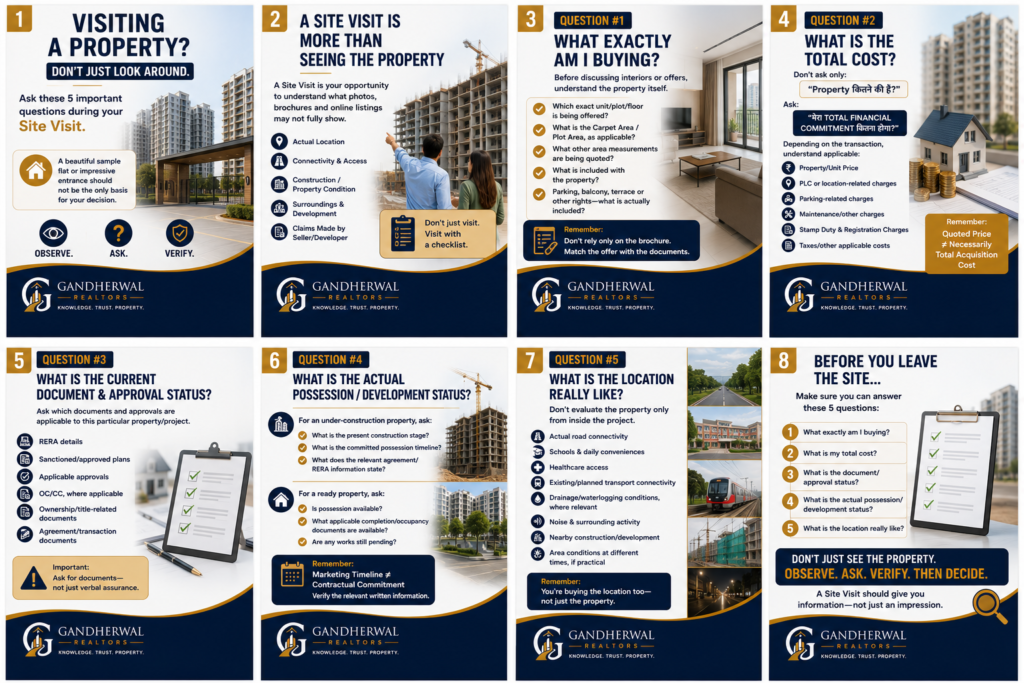
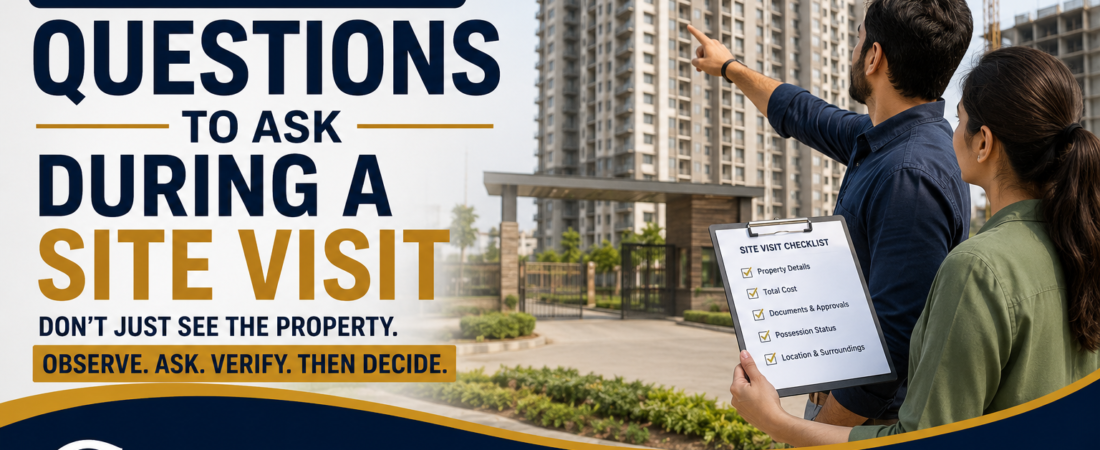
Here are 5 important questions every property buyer should ask during a Site Visit.
1. What Exactly Am I Buying?
This may sound obvious, but it should be one of your first questions.
The property shown during the visit may not necessarily be the exact unit, floor, plot or configuration being offered to you.
Ask clearly:
- Which exact unit, floor or plot is being offered?
- What is the Carpet Area or Plot Area, as applicable?
- Are any other area measurements being quoted?
- What is included in the offered price?
- Is parking included or separately allotted/charged?
- Are balcony, terrace or other areas/rights included?
- What specifications are actually being committed?
Sample Flat vs Actual Property
A sample flat is primarily a representation of how a property may look.
Its interiors, furniture, lighting, finishes or space utilisation can influence your perception of the property.
Therefore, don’t evaluate the purchase only on the basis of the sample flat.
Where relevant, compare what you are being shown or told with the floor plan, specifications, agreement and other applicable documents.
Remember:
Don’t rely only on the brochure or presentation. Match important claims with the relevant documents.
2. What Is My Total Financial Commitment?
One of the most important questions during a Site Visit is not simply:
“Property कितने की है?”
A better question is:
“मेरा Total Financial Commitment कितना होगा?”
The quoted or advertised property price may not represent the complete amount you will eventually spend.
Depending on the property and transaction, your financial commitment may involve:
- Basic/property consideration
- Preferential Location Charges (PLC), where applicable
- Parking-related charges, where applicable
- Maintenance-related charges/deposits
- Club or amenity-related charges, where applicable
- Stamp Duty
- Registration Charges
- Applicable taxes
- Other transaction-related costs
Not every charge applies to every transaction, so ask for a clear written cost sheet or price breakup, where available.
Why Does This Matter?
Suppose you shortlist two properties based only on their headline prices.
One appears cheaper.
But after considering applicable additional charges, the difference between the two may change significantly.
That is why comparison should ideally be based on the total financial commitment, not merely the advertised price.
Remember:
Quoted Property Price ≠ Necessarily Total Acquisition Cost
3. What Is the Current Document and Approval Status?
A Site Visit is also an opportunity to ask for information about the property’s documentation.
The exact documents required will depend on whether you are considering an under-construction project, ready property, plot, builder floor, resale property or another type of transaction.
Depending on the property, relevant checks may include:
- Ownership/title-related documents
- RERA registration and project information, where applicable
- Sanctioned/approved plans
- Applicable licences and approvals
- Occupancy Certificate (OC), where applicable
- Completion Certificate (CC), where applicable
- Agreement/transaction documents
- Relevant dues or encumbrance-related information
Ask for Documents, Not Just Assurances
There is an important difference between hearing:
“सब approvals हैं.”
and actually understanding which approvals apply and verifying the relevant documents.
Similarly, RERA registration is an important verification point for applicable projects, but it should not automatically be treated as a substitute for complete property due diligence.
If important documentation is not immediately available during the Site Visit, note what has been promised and verify it before making a major financial commitment.
Remember:
Verbal Assurance ≠ Document Verification
4. What Is the Actual Possession or Development Status?
This question becomes particularly important when evaluating an under-construction property.
Don’t evaluate progress only from one completed tower, a sample flat or the project entrance.
Ask:
- What is the current construction stage?
- What is the committed possession timeline?
- What timeline is mentioned in the relevant agreement?
- What does the applicable RERA information show?
- Which amenities and infrastructure are currently operational?
- Which facilities are still under development?
For a Ready Property
If the property is being represented as ready-to-move, ask:
- Is possession actually available?
- What work, if any, is still pending?
- Which applicable completion/occupancy documents are available?
- Are promised amenities operational?
- Are common areas and essential services functional?
The objective is to distinguish between what is currently available, what is under development and what is being promised for the future.
Remember:
Marketing Timeline ≠ Contractual Commitment
Important possession-related information should be checked against the relevant written documents.
5. What Is the Location Really Like?
You are not buying only a flat, floor, house or plot.
You are also buying into its location.
A project’s marketing material may highlight nearby highways, schools, hospitals, metro connectivity or future infrastructure.
These can be useful starting points, but a physical visit gives you the opportunity to examine the actual situation.
Check:
Road & Connectivity
How easy is it to reach the property?
Observe:
- Approach roads
- Traffic conditions
- Entry and exit points
- Last-mile connectivity
- Public transport availability, where relevant
Daily Conveniences
Look for practical facilities such as:
- Grocery and daily-needs stores
- Schools
- Hospitals/clinics
- Markets
- Banks/ATMs
- Public transport
The importance of each will depend on your own requirements.
Surrounding Development
Look beyond the project boundary.
Check for:
- Nearby construction
- Vacant land
- Commercial or industrial activity
- High-traffic roads
- Existing residential development
- Planned infrastructure
If future infrastructure is being presented as a major advantage, distinguish between what is already operational, officially approved/under implementation and merely proposed or marketed.
Visit at Different Times, If Practical
An area can feel very different in the afternoon compared with the morning or evening.
Where practical, observe:
- Peak-hour traffic
- Noise
- Street lighting
- General accessibility
- Waterlogging/drainage concerns
- Surrounding activity
Remember:
You’re buying the location too—not just the property.
Don’t Let the Site Visit Become a Sales Presentation
A Site Visit should primarily help you evaluate the property.
It should not become only a guided tour in which you see what the seller, developer or salesperson wants to show you.
Take time to:
Observe → Ask → Note → Compare → Verify
If possible, make notes or maintain a checklist for every property you visit.
This becomes particularly valuable when comparing several properties later because impressions can easily get mixed up.
Red Flags That Deserve Further Verification
A red flag does not automatically mean you should reject a property, but it can indicate that additional verification is required.
Pay closer attention if you encounter situations such as:
- Important questions repeatedly receiving vague answers
- Pressure to book immediately
- Major claims being made only verbally
- Reluctance to provide relevant documents
- Cost components not being explained clearly
- Significant difference between what was advertised and what you observe
- Possession or development timelines that cannot be supported by relevant information
- Important location disadvantages being avoided during discussion
Rather than making an immediate conclusion, identify the issue and verify it independently where appropriate.
Site Visit Checklist for Property Buyer
Before leaving the property, try to make sure you can answer these five questions:
☐ What exactly am I buying?
☐ What is my total financial commitment?
☐ What is the current document and approval status?
☐ What is the actual possession/development status?
☐ What is the location really like?
You can also note:
☐ Property/unit details
☐ Area measurements
☐ Price breakup
☐ Parking details
☐ Maintenance/other applicable charges
☐ Relevant documents promised/provided
☐ Construction/property condition
☐ Amenities currently available
☐ Road connectivity
☐ Nearby facilities
☐ Surrounding development
☐ Questions requiring follow-up
Final Thoughts
A Site Visit should do more than help you decide whether you like a property.
It should help you understand what you are buying, what it may actually cost, what documentation requires verification, what the current development status is and whether the location suits your requirements.
So, during your next property visit, don’t simply ask:
“Property कैसी लगी?”
Also ask:
“क्या मैंने इसे properly evaluate किया?”
The difference can be important.
DON’T JUST SEE THE PROPERTY.
OBSERVE. ASK. VERIFY. THEN DECIDE.
A good Site Visit should give you information—not just an impression.
Gandherwal Realtors
Knowledge. Trust. Property.
Planning Your Property Purchase?
Whether you are evaluating a flat, builder floor, plot or another residential property, a structured Site Visit can help you compare options more effectively and make a better-informed decision.
Gandherwal Realtors
📱 WhatsApp: +91 72064 77648
🌐 Website: gandherwalrealtors.com
Disclaimer: This article is intended for general educational purposes only and does not constitute legal, financial or professional advice. Property documents, approvals, charges and verification requirements vary according to the property, transaction and applicable regulations. Buyers should independently verify relevant information and seek appropriate professional advice where required.