Buying a property is one of the biggest financial decisions most people make. Whether you are purchasing a flat, builder floor, plot, independent house or another residential property, checking the price and location is only the beginning.
A property may look attractive, the project may have excellent amenities and the seller may provide convincing assurances—but proper verification of the property and its documents is essential before committing your money.
In this guide, we explain the important checks a buyer should consider before purchasing a property.
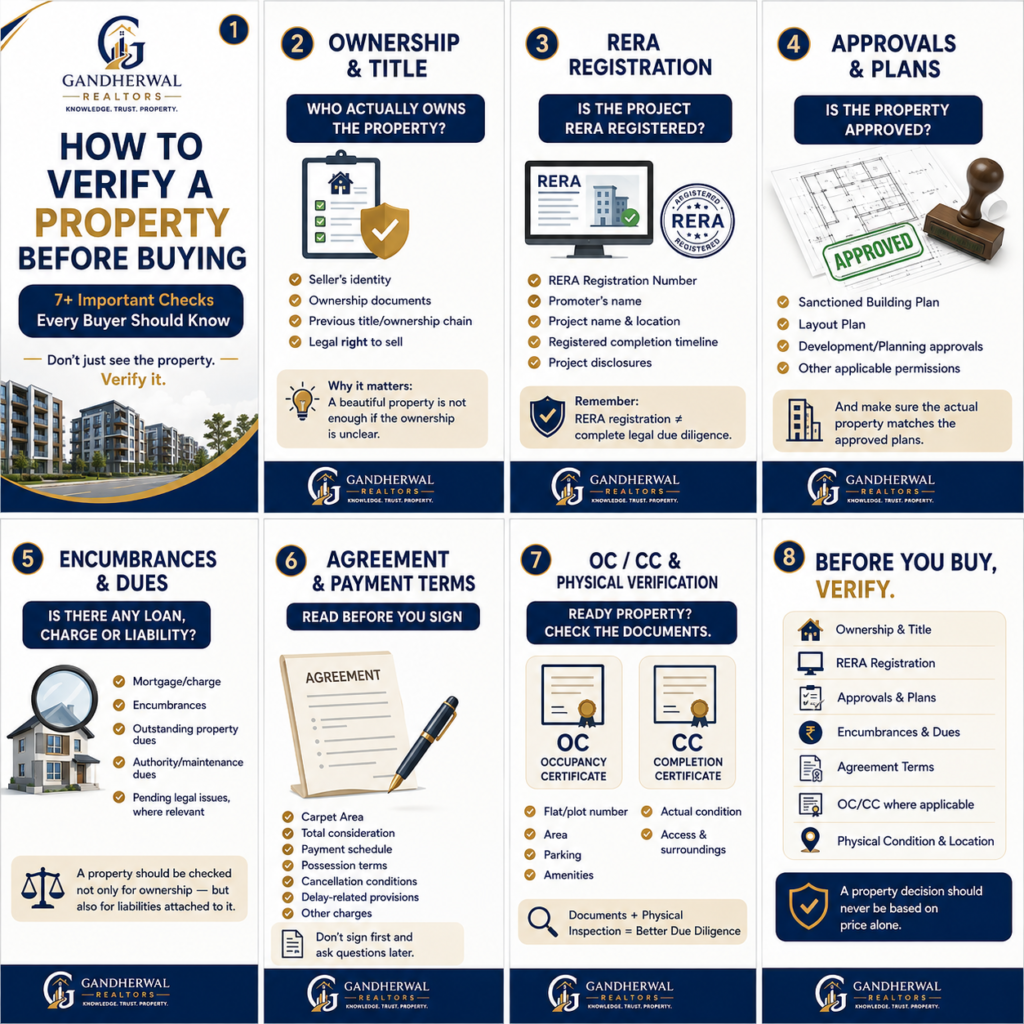
1. Verify the Ownership and Title
The first question should be simple:
Who legally owns the property?
Ask for the relevant title and ownership documents and verify whether the person or entity selling the property actually has the legal right to sell it.
Depending on the type and history of the property, the documents may include:
- Sale Deed
- Conveyance Deed
- Previous title documents
- Allotment documents
- Mutation records
- Other relevant ownership records
A buyer should also check whether the ownership has changed hands properly through previous transactions.
Important: Do not rely only on photocopies or verbal assurances. For a significant purchase, professional legal verification is advisable.
2. Check RERA Registration Where Applicable
For applicable real estate projects, check whether the project is registered with the relevant Real Estate Regulatory Authority (RERA).
The Real Estate (Regulation and Development) Act, 2016 establishes a framework for registration and regulation of real estate projects and agents. The Act also provides for public access to information about registered projects.
When checking a RERA registration, look at details such as:
- Project name
- Promoter/developer
- Registration number
- Project location
- Approved details available on the authority’s portal
- Declared completion timeline
- Project status
Don’t simply ask, “Is this project RERA approved?”
Instead, verify the actual registration details yourself.
3. Verify Approvals and Sanctioned Plans
A property should not be evaluated only on the basis of a brochure or sales presentation.
Where applicable, verify the relevant:
- Layout plan
- Building plan
- Sanctioned plan
- Commencement permissions
- Development permissions
- Other approvals issued by the competent authority
The RERA framework also requires promoters to provide relevant sanctioned and layout plans and project completion schedules to allottees.
The purpose of this check is to understand whether what has been promised to the buyer is consistent with the approved documentation.
4. Check for Encumbrances and Outstanding Dues
A property may have financial or legal liabilities attached to it.
Depending on the property, buyers should investigate whether there are:
- Existing loans or mortgages
- Charges on the property
- Outstanding maintenance dues
- Property tax dues
- Utility-related dues
- Other liabilities
For resale properties, this check becomes particularly important.
Never assume that the absence of an obvious dispute means the property has no liabilities.
The appropriate records should be examined before proceeding.
5. Carefully Read the Agreement
Many buyers concentrate on the price and payment schedule but do not read the complete agreement carefully.
Before signing, understand:
- Total consideration
- Payment schedule
- Possession terms
- Cancellation provisions
- Default provisions
- Maintenance obligations
- Additional charges
- Parking terms
- Common-area provisions
- Other important contractual conditions
For applicable RERA projects, the Act also regulates matters relating to agreements for sale and advance payments.
If a clause is unclear, ask for clarification before signing—not after signing.
6. Verify OC/CC Where Applicable
For completed projects, buyers should understand the status of the relevant completion documentation.
Depending on the property and applicable local regulations, this may include:
- Completion Certificate (CC)
- Occupancy Certificate (OC)
These documents can be important indicators of the regulatory status of a completed development.
However, requirements can differ according to the property type, local authority and applicable regulations. Therefore, buyers should verify the documents relevant to their particular property.
7. Physically Inspect the Property
Documents are extremely important—but physical verification matters too.
During a site visit, compare the actual property with the documents and representations provided to you.
Check:
- Actual location
- Unit number
- Floor
- Size and layout
- Access
- Parking
- Common areas
- Construction condition
- Water and electricity arrangements
- Surrounding development
- Actual amenities and infrastructure
For an under-construction project, also compare the actual progress with the information provided by the developer.
8. Check the Total Cost—Not Just the Advertised Price
A property advertised at a particular price may involve several additional costs.
Depending on the transaction, these may include:
- Stamp duty
- Registration charges
- Maintenance-related charges
- Parking charges
- Other applicable taxes or statutory charges
- Brokerage, where applicable
- Loan-related costs
- Other transaction-specific expenses
Therefore, instead of asking only:
“What is the property price?”
ask:
“What will be my approximate total acquisition cost?”
A clear cost sheet can help you compare properties more realistically.
9. Verify the Seller or Developer
For a resale property, understand the seller’s ownership and transaction history.
For a developer project, examine available information about the promoter and the project.
Under RERA, project registration information includes details relating to the promoter and the project, and the regulatory authority is required to maintain publicly accessible project records.
This can help a buyer conduct a more informed preliminary assessment.
10. Don’t Treat RERA Registration as a Complete Property Verification
This is an important distinction.
RERA registration is valuable—but it is not the same as complete due diligence.
A buyer should still examine:
Title + Ownership + Approvals + RERA + Encumbrances + Agreement + Physical Property + Total Cost
Think of these as different pieces of the same verification process.
A property can have a RERA registration and still require careful examination of the specific transaction and documents.
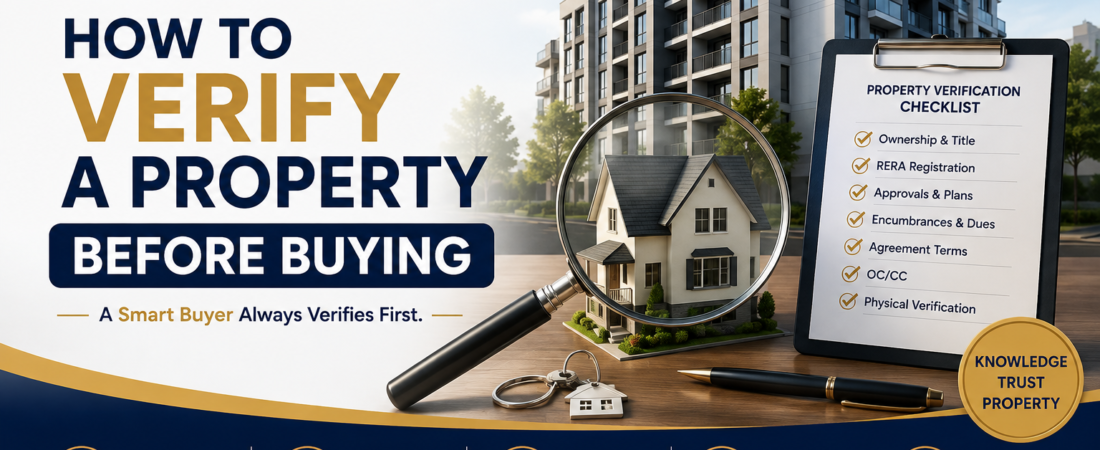
A Simple Property Verification Checklist
Before proceeding, ask yourself:
☐ Have I verified the ownership/title?
☐ Have I checked RERA registration, where applicable?
☐ Have I examined relevant approvals and sanctioned plans?
☐ Have I checked for encumbrances and outstanding dues?
☐ Have I understood the agreement terms?
☐ Have I checked OC/CC where applicable?
☐ Have I physically inspected the property?
☐ Have I calculated the complete acquisition cost?
☐ Have I independently verified important documents?
☐ Have I taken professional legal advice where necessary?
If several answers are “No”, it may be better to pause before making a major financial commitment.
Final Thoughts
Buying property should not be based solely on price, location, amenities or a convincing sales pitch.
A well-informed buyer takes the time to verify the property, understand the documents and evaluate the complete transaction.
The simple principle is:
Don’t buy a property only because it looks right. Buy after verifying that it is right.
At Gandherwal Realtors, we believe that better property decisions begin with better property knowledge.
Knowledge. Trust. Property.
Need Help With Your Property Decision?
Whether you are considering a flat, builder floor, plot or another residential property, proper evaluation can help you make a more informed decision.
Gandherwal Realtors
📱 WhatsApp: +91 72064 77648
🌐 Website: www.gandherwalrealtors.com
Disclaimer: This article is intended for general educational purposes and should not be treated as legal, financial or professional advice. Property laws, approval requirements and documentation can vary according to the property, transaction and jurisdiction. Buyers should obtain appropriate professional advice and independently verify documents before proceeding with a property transaction.