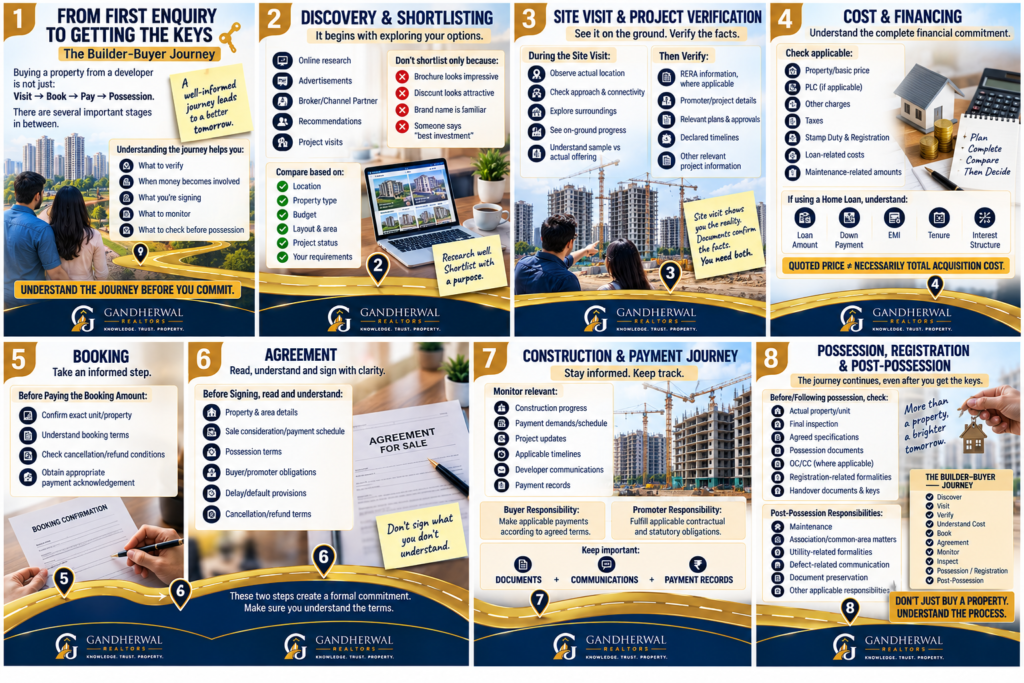
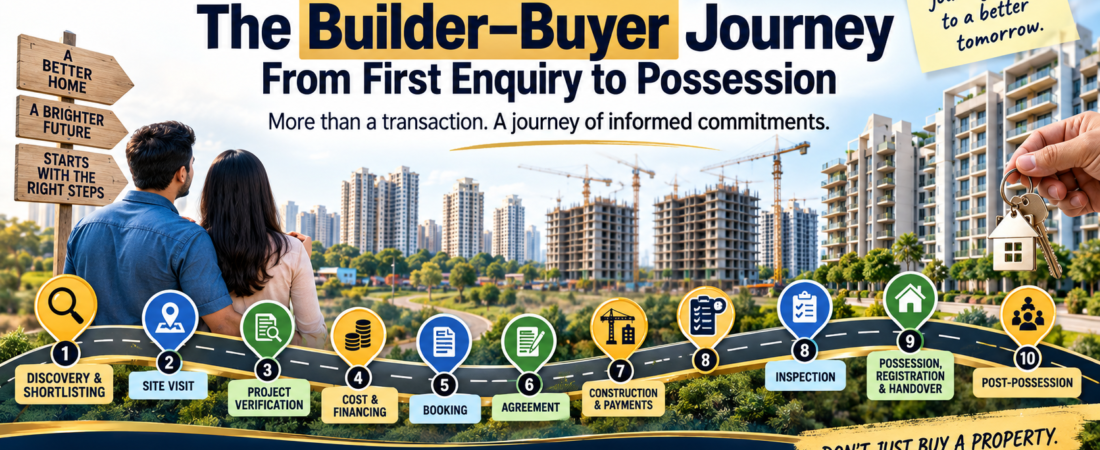
Buying a property from a developer is often imagined as a simple process:
Visit → Book → Pay → Possession
In reality, the Builder–Buyer Journey involves several stages.
A buyer may first discover a project online, visit the site, discuss pricing, verify project information, pay a booking amount, sign relevant documents, make payments during construction, monitor progress, inspect the property and eventually complete applicable possession, registration and handover formalities.
At each stage, the nature of the buyer’s commitment can change.
That is why understanding the complete journey is important before making a major financial commitment.
A useful way to approach the process is:
KNOW → VERIFY → DOCUMENT → THEN PROCEED
Let’s understand the Builder–Buyer Journey step by step.
1. Discovery: Where the Builder–Buyer Journey Begins
For many buyers, the journey begins long before they visit a project.
You may discover a property through:
- Online property portals
- Social media
- Developer advertisements
- Search engines
- Broker or Channel Partner
- Friends or relatives
- Outdoor advertising
- Property exhibitions
- Previous knowledge of the developer
At this stage, marketing material is useful for discovery.
But discovery should not be confused with verification.
An attractive advertisement may help you identify a project worth exploring, but it should not by itself determine your purchase decision.
The first question should not be:
“क्या यह project अच्छा है?”
Instead, start with:
“क्या यह project मेरी requirements के लिए relevant है?”
2. Shortlisting: Match the Project With Your Requirements
Before visiting every available project, shortlist those that broadly match your needs.
Consider:
- Self-use or investment
- Budget
- Location
- Property type
- Property size
- Layout
- Construction status
- Possession requirements
- Amenities
- Connectivity
- Family requirements
- Long-term plans
This is important because a project can be good in general and still not be the right project for you.
For example, a buyer looking for immediate self-use may evaluate an under-construction property differently from someone with a longer time horizon.
Similarly, a buyer prioritising daily commute may make a different location choice from someone prioritising larger space.
Shortlist with a purpose.
Don’t shortlist merely because:
- The discount looks attractive
- The sample flat looks premium
- The developer is well known
- Someone calls it a “great investment”
3. Site Visit: Understand the Physical Reality
Once a project is shortlisted, a personal Site Visit can provide valuable context.
A website can show photographs.
A brochure can show layouts.
A location map can show distances.
But a site visit helps you experience the property and its surroundings personally.
During the visit, observe:
Location & Connectivity
Check:
- Main approach road
- Road condition
- Traffic
- Public transport
- Nearby highways/major roads
- Schools
- Hospitals
- Markets
- Daily conveniences
Surroundings
Observe:
- Existing neighbourhood
- Nearby construction
- Commercial activity
- Open/vacant land
- Noise
- Traffic
- General environment
Project Status
For an under-construction project, observe:
- Construction activity
- Towers/blocks
- Internal roads
- Amenities under development
- Overall site progress
Sample vs Actual Offering
If you visit a sample flat, understand which features are actually included in the property being offered.
Remember:
SITE VISIT ≠ DOCUMENT VERIFICATION
A site visit helps you understand physical reality.
It does not automatically establish title, approvals, regulatory compliance or the accuracy of every project representation.
4. Project Verification: Move From Claims to Information
After understanding the project physically, the next stage is verification.
For applicable projects, relevant checks may include:
- RERA registration/information
- Promoter details
- Project details
- Relevant plans
- Applicable approvals/licences
- Declared timelines
- Project status
- Other available disclosures
Buyers should use relevant official sources and project documentation, where applicable, rather than relying entirely on verbal information.
Remember:
RERA Registration ≠ Complete Due Diligence
RERA information can be an important part of project verification, but it does not eliminate the need to examine other relevant property and transaction information.
The exact verification required depends on the property and transaction.
5. Understand the Builder’s Track Record
Before committing to a developer project, research the promoter/developer as well.
Consider relevant:
- Completed projects
- Ongoing projects
- Delivery history
- Construction quality
- Maintenance of completed developments
- Existing buyer/resident experiences
- Publicly available project information
Where practical, visiting a completed project by the same developer can provide useful context.
However:
PAST PERFORMANCE ≠ GUARANTEE OF FUTURE PERFORMANCE
A developer’s reputation can help provide context, but the specific project should still be evaluated independently.
6. Understand the Complete Financial Commitment
Price discussions often begin with a number such as:
₹X per sq. ft.
or:
₹X lakh onwards
But buyers need to understand what that figure includes—and what it does not.
Depending on the property and transaction, the total financial commitment may include:
- Property/basic price
- PLC, where applicable
- Other project-related charges
- Applicable taxes
- Maintenance-related amounts
- Stamp Duty
- Registration Charges
- Loan-related costs
- Other applicable transaction expenses
Ask for a detailed cost sheet or price breakup, where available.
Remember:
QUOTED PRICE ≠ NECESSARILY TOTAL ACQUISITION COST
Before booking, you should have a reasonable understanding of the complete financial picture.
7. Financing: Understand Your Home Loan Before Committing
If you plan to use a home loan, financing should form part of your decision-making before a major commitment is made.
Understand:
- Loan eligibility
- Own contribution/down payment
- Loan amount
- Interest-rate structure
- EMI
- Loan tenure
- Processing and other applicable charges
- Prepayment-related terms
- Your repayment comfort
Don’t assume:
“Bank loan approve कर देगा, इसलिए property affordable है.”
Loan eligibility and comfortable affordability are not necessarily the same thing.
The property should fit your broader financial situation.
8. Booking: The Journey Becomes More Serious
Once a buyer decides to proceed, the developer may ask for a booking amount or application-related payment, depending on the transaction.
Before paying, understand:
- Exact project
- Exact tower/block, where applicable
- Exact unit/property, where identified
- Property configuration
- Booking amount
- Payment schedule
- Booking/application terms
- Cancellation conditions
- Refund conditions
- Relevant deductions, where applicable
- Correct payment recipient/entity
Obtain appropriate acknowledgement or receipt for payments made.
Don’t ask only:
“Booking amount कितना है?”
Also ask:
“What exactly am I agreeing to by paying it?”
A relatively small booking amount can lead to a much larger financial commitment.
Therefore:
DON’T BOOK FIRST. VERIFY FIRST.
9. Written Documentation: Move Beyond Verbal Assurances
During the sales process, buyers may hear statements relating to:
- Possession
- Pricing
- Discounts
- Amenities
- Specifications
- View
- Location advantage
- Payment flexibility
- Other project features
Important representations affecting your decision should be understood in the context of the relevant written documentation.
Remember:
VERBAL ASSURANCE ≠ WRITTEN COMMITMENT
If something is important enough to influence your decision, understand how it is appropriately reflected in the relevant project/transaction documents.
10. Agreement Stage: Understand Before You Sign
The relevant agreement between the buyer and promoter is one of the most important stages of the journey.
Don’t treat it as a routine document that merely needs a signature.
Depending on the transaction, review important provisions relating to:
- Property/unit details
- Area
- Sale consideration
- Payment schedule
- Possession
- Specifications
- Buyer obligations
- Promoter obligations
- Cancellation
- Refund
- Delay/default
- Interest or other consequences, where applicable
- Maintenance
- Transfer
- Dispute-related provisions
- Other relevant terms
Take time to understand what you are agreeing to.
Where appropriate, seek qualified professional advice.
The rule is simple:
READ. UNDERSTAND. VERIFY. THEN SIGN.
11. Construction Stage: Stay Informed After Booking
For an under-construction property, the buyer’s journey does not stop after signing.
The relationship may continue for months or years during the construction period.
Stay informed about relevant:
- Construction progress
- Payment schedule
- Payment demands
- Project communications
- Applicable timelines
- Updates provided by the promoter
- Important notices
Where relevant, compare available project updates with appropriate official/project information.
The purpose is not to monitor construction every day.
It is to remain an informed buyer throughout the transaction.
12. Payment Journey: Keep Proper Records
Property transactions can involve multiple payments over time.
Maintain organised records of:
- Booking payment
- Instalments
- Demand letters
- Payment receipts
- Loan disbursements
- Applicable charges
- Relevant correspondence
Also preserve important emails, letters and other communications relating to the transaction.
A simple digital folder can be useful.
For example:
Property Documents
→ Booking
→ Agreement
→ Payments
→ Loan
→ Developer Communications
→ RERA/Project Information
→ Possession
→ Registration
→ Handover
Good record-keeping can make the entire journey easier to track.
13. Buyer Responsibilities Matter Too
Buyer education should not focus only on what the developer must do.
Buyers also have responsibilities.
Depending on the transaction and applicable terms, these may include:
- Making payments as agreed
- Providing required documents
- Responding to relevant communications
- Completing loan-related formalities
- Completing applicable registration requirements
- Following agreed terms
- Keeping records
A well-informed buyer should understand both sides of the transaction.
14. Promoter Responsibilities Should Be Understood
Similarly, promoters have contractual and, where applicable, statutory obligations.
These can relate to matters such as:
- Project information
- Applicable approvals
- Construction/development
- Agreed specifications
- Relevant disclosures
- Possession
- Other obligations under applicable law and agreements
The exact obligations depend on the project, agreement and applicable regulatory framework.
This is another reason why buyers should understand the relevant documents rather than relying only on sales conversations.
15. Construction Delay: Know What the Documents Say
Delays can be one of the most important concerns in an under-construction purchase.
Before booking, understand:
- Contractual possession timeline
- Relevant conditions
- Delay-related provisions
- Applicable buyer rights/remedies
- Relevant RERA information, where applicable
Under applicable RERA provisions, buyers may have certain rights where a promoter fails to complete or give possession according to the applicable terms, subject to the law and facts of the case.
However, buyers should avoid relying on simplified statements such as:
“Delay हुआ तो automatically ऐसा होगा.”
Legal outcomes depend on the applicable law, agreement, circumstances and relief sought.
For specific disputes, appropriate professional/legal advice may be necessary.
16. Possession Stage: Don’t Focus Only on Getting the Keys
After waiting for possession, receiving the keys can understandably feel like the end of the journey.
But before completing applicable possession/handover formalities, inspect the property carefully.
Where relevant, check:
- Actual unit/property
- Agreed layout
- Visible condition
- Fixtures/specifications
- Doors/windows
- Electrical points
- Plumbing
- Finishing
- Common areas
- Parking, where applicable
- Other agreed features
Record relevant observations and raise appropriate concerns through the applicable process.
Remember:
KEYS ≠ EVERYTHING VERIFIED
Possession is an important milestone, but applicable documentation and transaction formalities still matter.
17. Check Applicable Completion and Occupancy Documents
Depending on the property, project and local regulatory framework, relevant completion or occupancy-related documentation may be important.
These may include:
- Completion Certificate (CC), where applicable
- Occupancy Certificate (OC), where applicable
- Other relevant possession/completion documents
Do not assume that the terminology, applicability or process is identical for every property or jurisdiction.
Verify what is relevant to your specific transaction.
18. Registration and Handover
Depending on the transaction, applicable registration, possession and handover formalities must be completed.
These may involve:
- Stamp Duty
- Registration Charges
- Execution/registration of relevant instrument
- Final payment reconciliation
- Handover documents
- Keys/access devices
- Maintenance-related documentation
- Other applicable records
The exact sequence can differ according to the property and transaction.
For this reason, avoid assuming that every builder–buyer journey follows an identical:
Possession → Registration → Handover
sequence.
Understand the process applicable to your transaction.
19. Post-Possession: The Journey May Continue
Receiving possession does not necessarily end every builder–buyer interaction.
Depending on the project, post-possession matters may include:
- Maintenance
- Common-area issues
- Association-related matters
- Utility formalities
- Defect-related communication, where applicable
- Pending documentation
- Other project-specific matters
Keep your important documents and communications organised even after moving into the property.
The Builder–Buyer Journey at a Glance
The complete journey can be understood as:
1. DISCOVER
Find potentially suitable projects.
↓
2. SHORTLIST
Match projects with your requirements and budget.
↓
3. VISIT
Understand the physical reality.
↓
4. VERIFY
Check relevant project, promoter and property information.
↓
5. UNDERSTAND COST
Know your complete financial commitment.
↓
6. BOOK
Understand the terms before paying.
↓
7. AGREEMENT
Read before signing.
↓
8. MONITOR
Track relevant construction, payments and communications.
↓
9. INSPECT
Check the actual property before/following possession as applicable.
↓
10. COMPLETE THE TRANSACTION
Complete relevant possession, registration and handover formalities.
↓
11. POST-POSSESSION
Preserve records and understand continuing responsibilities.
Five Important Principles Throughout the Journey
Whatever stage you are at, keep these five principles in mind.
1. Don’t Confuse Marketing With Verification
Marketing helps you discover a project.
Verification helps you evaluate it.
2. Don’t Confuse a Site Visit With Due Diligence
Seeing the property physically is important, but documents and official information require separate verification.
3. Don’t Confuse Quoted Price With Total Cost
Understand the complete financial commitment.
4. Don’t Confuse Verbal Assurances With Written Terms
Important matters should be understood through appropriate documentation.
5. Don’t Confuse Possession With the End of Every Responsibility
Registration, handover, documentation, maintenance and other matters may still require attention depending on the transaction.
Questions Every Buyer Should Keep Asking
Throughout the Builder–Buyer Journey, repeatedly ask:
What am I being told?
Understand the representation being made.
What can I verify?
Look for relevant documentation, official information and physical evidence.
What am I paying for?
Understand every significant financial commitment.
What am I signing?
Read the relevant terms before accepting them.
What should I preserve?
Keep important documents, receipts and communications.
These five questions can help transform the buyer from a passive recipient of information into a more informed participant in the transaction.
Final Thoughts
Buying property from a developer should not be viewed as a single event.
It is a journey involving:
Information → Verification → Financial Commitment → Documentation → Construction/Progress → Inspection → Transaction → Possession → Post-Possession
At different stages, different questions become important.
Before the Site Visit, you are evaluating whether the project deserves further consideration.
Before Booking, you are deciding whether it deserves your money.
Before Signing, you are deciding whether you understand and accept the terms.
During Construction, you are tracking your continuing commitment.
Before Possession, you are checking what is actually being handed over.
And after possession, you still need to preserve documents and understand applicable continuing responsibilities.
The goal is not to make property buying complicated.
The goal is to understand the process before important decisions become difficult to reverse.
So remember:
DON’T JUST BUY A PROPERTY. UNDERSTAND THE PROCESS.
KNOW → VERIFY → DOCUMENT → THEN PROCEED
Gandherwal Realtors
Knowledge. Trust. Property
Planning to Buy a Property From a Developer?
Understanding the Builder–Buyer Journey can help you know what to ask, what to verify, what to document and when to seek appropriate professional advice.
Take your time before making significant financial or contractual commitments.
Gandherwal Realtors
📱 WhatsApp: +91 72064 77648
🌐 Website: gandherwalrealtors.com
Disclaimer: This article is intended for general educational purposes only and does not constitute legal, financial, investment or professional advice. Project information, contractual terms, regulatory requirements, registration procedures and buyer/promoter obligations vary according to the property, project, jurisdiction and transaction. Buyers should independently verify relevant information and seek appropriate professional advice where required.