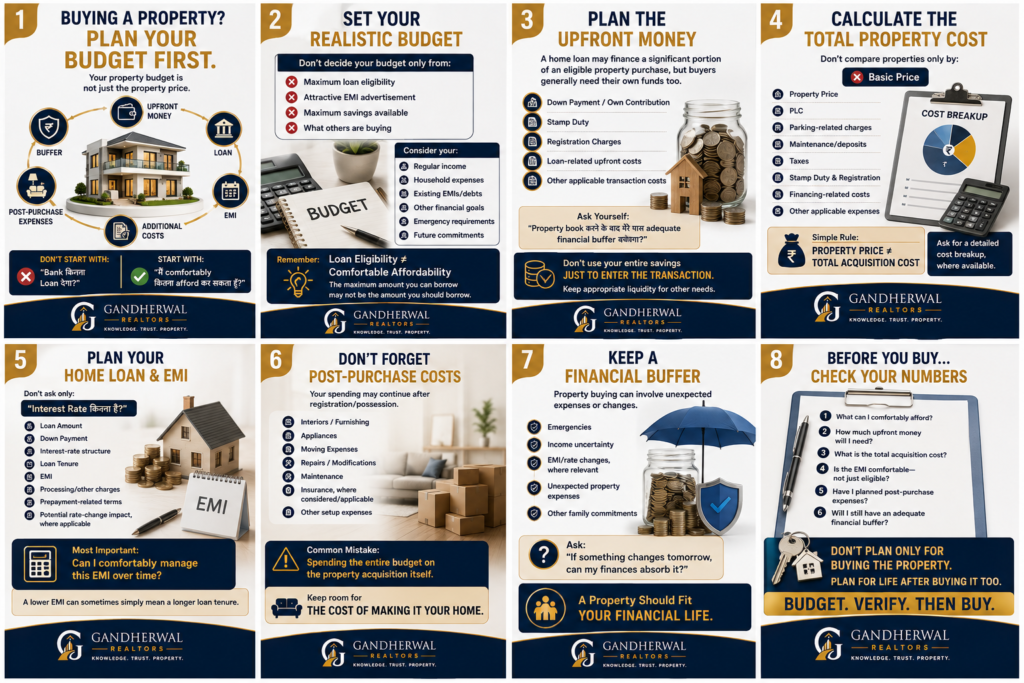

Buying a property is one of the biggest financial commitments many people make.
Naturally, buyers spend considerable time comparing locations, projects, builders, layouts, amenities and property prices. But one important step should ideally come even before serious property shortlisting:
Budget Planning
A common starting question is:
“Bank मुझे कितना Home Loan देगा?”
But loan eligibility alone does not tell you whether a property is comfortably affordable.
A better question is:
“मैं comfortably कितना afford कर सकता हूँ?”
Your property budget should take into account much more than the advertised property price. It may include your own contribution, home loan, EMI, applicable transaction costs, post-purchase expenses and an appropriate financial buffer.
Let’s understand how to plan a property budget more systematically.
1. Start With Comfortable Affordability
The maximum amount you may be eligible to borrow is not necessarily the amount you should borrow.
Before deciding your property budget, look at your broader financial position.
Consider:
- Regular income
- Household expenses
- Existing EMIs or debts
- Education and family expenses
- Insurance commitments
- Other financial goals
- Expected future expenses
- Income stability
- Emergency requirements
For example, two buyers earning the same monthly income may have very different levels of affordability.
One may have no existing debt and relatively limited financial commitments.
The other may already have a car loan, education expenses and other family responsibilities.
Therefore, property affordability is personal.
Remember:
Loan Eligibility ≠ Comfortable Affordability
The question is not merely whether a lender is willing to finance the purchase.
The more important question is whether you can comfortably manage the financial commitment over time.
2. Decide How Much Upfront Money You Will Need
A property purchase generally requires buyers to arrange some money from their own resources.
Depending on the transaction, upfront funds may include:
- Down payment / own contribution
- Booking amount
- Stamp Duty
- Registration Charges
- Loan-related upfront expenses
- Applicable taxes or transaction costs
- Other applicable charges
The exact amount and components will vary according to the property and transaction.
Don’t Use Your Entire Savings Just to Enter the Transaction
Suppose you have accumulated significant savings for your home purchase.
It may be tempting to use nearly all of them towards the property.
But ask yourself:
“Property book करने के बाद मेरे पास adequate financial flexibility बचेगी?”
A property purchase should ideally not leave you without resources for other important financial needs.
Your home is important—but so are your day-to-day expenses, emergencies and other financial commitments.
3. Calculate the Total Acquisition Cost
One of the biggest budgeting mistakes is assuming:
Property Price = Total Amount Required
That may not be the case.
Depending on the property and transaction, your financial commitment may include:
- Basic/property price
- Preferential Location Charges (PLC), where applicable
- Parking-related charges, where applicable
- Maintenance-related charges/deposits
- Other project-related charges
- Applicable taxes
- Stamp Duty
- Registration Charges
- Financing-related expenses
- Other transaction costs
Not every charge applies to every property.
The objective is to identify which costs apply to the specific property you are considering.
Therefore:
PROPERTY PRICE ≠ NECESSARILY TOTAL ACQUISITION COST
4. Ask for a Detailed Cost Breakup
Where available, ask the developer/seller or relevant party for a detailed written cost sheet or price breakup.
Instead of looking only at:
₹X per sq. ft.
try to understand the complete calculation.
Check:
- Applicable area
- Rate
- Basic/property price
- PLC, if applicable
- Other applicable project charges
- Applicable taxes
- Maintenance-related amounts
- Payment schedule
- Other applicable costs
A written cost breakup can also help when comparing two projects.
Example
Suppose:
Property A has a lower advertised basic rate.
Property B has a slightly higher basic rate.
At first glance, Property A may appear cheaper.
But after considering the applicable charges and transaction costs, the difference may reduce—or the overall comparison may change.
Therefore:
Compare Complete Costs, Not Just Headline Prices
5. Plan Your Home Loan Carefully
If you intend to finance the purchase through a home loan, don’t focus only on:
“Interest Rate कितना है?”
Several factors can affect your overall borrowing experience.
Understand:
- Loan amount
- Own contribution/down payment
- Interest-rate structure
- Fixed/floating features, as applicable
- Loan tenure
- EMI
- Processing and other applicable charges
- Prepayment-related terms
- Potential impact of interest-rate changes, where applicable
The cheapest-looking loan at first glance may not necessarily be the most suitable one for your circumstances.
6. Don’t Evaluate a Home Loan Only by EMI
EMI is important because it affects your monthly cash flow.
But a low EMI does not automatically mean a better loan.
Why?
Because EMI can be influenced by factors such as:
- Loan amount
- Interest rate
- Loan tenure
A longer tenure may reduce the monthly EMI but can also affect the total interest paid over the life of the loan.
Therefore, compare:
EMI + Tenure + Interest Structure + Applicable Charges + Loan Terms
rather than looking at EMI alone.
The central question should remain:
“Can I comfortably manage this EMI over time?”
7. Consider Your Existing Financial Commitments
A home loan does not exist in isolation.
You may already be paying:
- Car loan EMI
- Personal loan EMI
- Education loan
- Credit-related obligations
- Insurance premiums
- School/education expenses
- Rent
- Regular household costs
Before adding a home-loan EMI, consider how the combined commitments affect your monthly finances.
Avoid constructing a property budget that works only when everything goes perfectly every month.
A sustainable budget should leave some room for normal changes in life.
8. Don’t Forget Post-Purchase Expenses
Your financial planning should not stop at registration or possession.
A newly purchased home may require additional spending.
Depending on the property, these expenses could include:
- Interiors
- Furniture
- Appliances
- Lighting
- Curtains/furnishings
- Repairs or modifications
- Moving expenses
- Maintenance
- Utility setup
- Insurance, where considered/applicable
- Other household setup costs
These expenses can be substantial depending on the buyer’s requirements.
Common Mistake:
Spending the Entire Budget on Property Acquisition
If your complete available budget is committed to purchasing the property, you may later find yourself borrowing or compromising for basic setup expenses.
Therefore:
Keep Room for the Cost of Making It Your Home.
9. Maintain an Appropriate Financial Buffer
Property purchases can involve unexpected expenses.
Life can too.
Your financial plan should therefore not necessarily assume that:
- Income will never change
- Interest rates will never change
- Repairs will never arise
- Family expenses will remain constant
- No emergency will occur
An appropriate financial buffer can provide flexibility for situations such as:
- Unexpected household expenses
- Temporary income disruption
- Medical or family emergencies
- Property-related expenses
- EMI changes where relevant
- Repairs or maintenance
- Other unforeseen commitments
There is no single buffer amount that is automatically correct for every buyer.
The appropriate level depends on factors such as your income stability, family responsibilities, existing liabilities and overall financial position.
A useful question is:
“If something changes tomorrow, can my finances absorb it?”
10. Don’t Let Loan Eligibility Define Your Property Budget
Suppose a lender tells you that you may be eligible for a particular loan amount.
It can be tempting to increase your property budget accordingly.
But your lender and you are answering two different questions.
The lender is broadly assessing:
“How much can potentially be financed under our lending criteria?”
You should be asking:
“How much can I comfortably repay while maintaining my other financial priorities?”
Those numbers do not necessarily have to be identical.
Remember:
MAXIMUM ELIGIBILITY ≠ IDEAL BORROWING AMOUNT
11. Keep Your Other Financial Goals in the Picture
Buying a home is important, but it may not be your only financial goal.
You may also be planning for:
- Children’s education
- Retirement
- Emergency reserves
- Vehicle purchase
- Family responsibilities
- Travel
- Business/professional goals
- Other investments
A property purchase should be considered within your overall financial plan, rather than consuming every available resource simply because you qualify for a larger loan.
12. Ready-to-Move vs Under-Construction: Budgeting Can Differ
Your cash-flow planning may also depend on the type and stage of property.
For example, with a ready-to-move property, the timing of payments, registration, possession and setup expenses may be relatively concentrated.
With an under-construction property, payments may follow an agreed schedule or construction-linked structure, depending on the transaction.
If you are currently paying rent while also making property-related payments, consider how the overlap could affect your finances.
Therefore, don’t consider only:
How much will I pay?
Also consider:
When will I need to pay it?
Cash-flow timing can be almost as important as the total amount.
13. Budget for Stamp Duty and Registration Charges Separately
Buyers sometimes focus heavily on the negotiated property price and home-loan amount but underestimate transaction-related statutory costs.
Stamp Duty and Registration Charges can form an important part of the acquisition budget.
Their applicability and amount can vary depending on factors such as the state, property, transaction and applicable rules.
Therefore, before finalising your budget:
- Check the applicable rates
- Understand how the amount is calculated
- Identify when payment is required
- Keep the required funds available
Don’t assume these expenses will automatically be included in your quoted property price.
14. Include PLC and Other Applicable Charges in Comparisons
Two similar units in the same project may have different total costs.
One reason can be Preferential Location Charges (PLC) or other applicable location/project-related pricing components.
For example, depending on the project, a unit may carry an additional charge for a particular:
- Facing
- View
- Location
- Floor
- Corner position
- Other preference
When comparing units, ask:
“What exactly am I paying extra for?”
And:
“Is this preference worth the additional cost for me?”
A feature labelled “preferred” does not automatically mean it is worth paying extra for every buyer.
15. Don’t Let the Booking Amount Distract You From the Bigger Picture
A booking amount may look small compared with the total property price.
For example:
“Sir, अभी सिर्फ ₹X देकर unit book कर दीजिए.”
But the relevant question is not whether you can afford the booking amount.
The relevant question is whether you can comfortably manage the entire transaction that follows.
Before paying a booking amount, understand:
- Exact property/unit
- Total cost
- Payment schedule
- Financing requirement
- Booking terms
- Cancellation/refund conditions
- Relevant documentation
Remember:
Booking Amount ≠ Property Affordability
A Practical Property Budget Framework
Before buying, divide your financial planning into these six buckets:
1. PROPERTY ACQUISITION
Basic/property price and applicable project-related costs.
2. UPFRONT MONEY
Down payment, Stamp Duty, Registration and other applicable upfront expenses.
3. FINANCING
Loan amount, EMI, tenure, interest structure and applicable loan costs.
4. POST-PURCHASE
Interiors, furniture, appliances, moving and setup expenses.
5. ONGOING COSTS
Maintenance and other recurring property-related expenses.
6. FINANCIAL BUFFER
Funds retained for emergencies and unexpected requirements.
Looking at all six together provides a much more realistic picture than simply asking:
“Property का price कितना है?”
Property Budget Checklist
Before committing to a property, ask yourself:
☐ Have I calculated what I can comfortably afford?
☐ Have I considered my existing EMIs and financial commitments?
☐ Do I know how much upfront money I will need?
☐ Have I calculated the total acquisition cost?
☐ Have I obtained a detailed cost breakup, where available?
☐ Do I understand the applicable PLC and other charges?
☐ Have I budgeted for Stamp Duty and Registration Charges?
☐ Do I understand my home-loan structure?
☐ Is the EMI comfortable over the long term?
☐ Have I considered the loan tenure and applicable charges?
☐ Have I planned for interiors and post-purchase expenses?
☐ Have I considered the timing of different payments?
☐ Will I still retain an appropriate financial buffer?
☐ Does this purchase leave room for my other financial goals?
If several of these answers are unclear, your property search may be ahead of your financial planning.
Final Thoughts
Property budget planning is not about finding the maximum amount you can spend.
It is about identifying the amount you can spend comfortably and sustainably.
Before buying, understand:
How much money you need upfront.
How much the complete transaction may cost.
How much you need to borrow.
Whether the EMI is comfortable.
What expenses may arise after possession.
How much financial flexibility you will retain.
The goal should not simply be:
“Can I buy this property?”
A better question is:
“Can I buy this property and still maintain a financially comfortable life afterwards?”
Because a home should provide stability—not create unnecessary financial pressure.
**DON’T PLAN ONLY FOR BUYING THE PROPERTY.
PLAN FOR LIFE AFTER BUYING IT TOO.**
BUDGET. VERIFY. THEN BUY.
Gandherwal Realtors
Knowledge. Trust. Property.
Planning to Buy a Property?
Before shortlisting properties, take time to understand your realistic budget, complete acquisition cost, financing requirements and post-purchase expenses.
Better budget planning can help you compare properties on what they may actually cost—not simply on the price displayed in an advertisement.
Gandherwal Realtors
📱 WhatsApp: +91 72064 77648
🌐 Website: gandherwalrealtors.com
Disclaimer: This article is intended for general educational purposes only and does not constitute financial, investment, legal, tax or lending advice. Property costs, loan terms, interest rates, taxes, duties and other charges vary according to the buyer, lender, property, transaction and applicable rules. Buyers should verify current information and consider obtaining appropriate professional advice based on their individual financial circumstances.