Buying a home is one of the most important financial decisions many people make.
But the home-buying process is often approached like this:
Search → Visit → Book → Pay
A buyer sees an advertisement, visits a project, likes the property, discusses the price and may quickly move towards paying the booking amount.
A better approach is to treat home buying as a structured process.
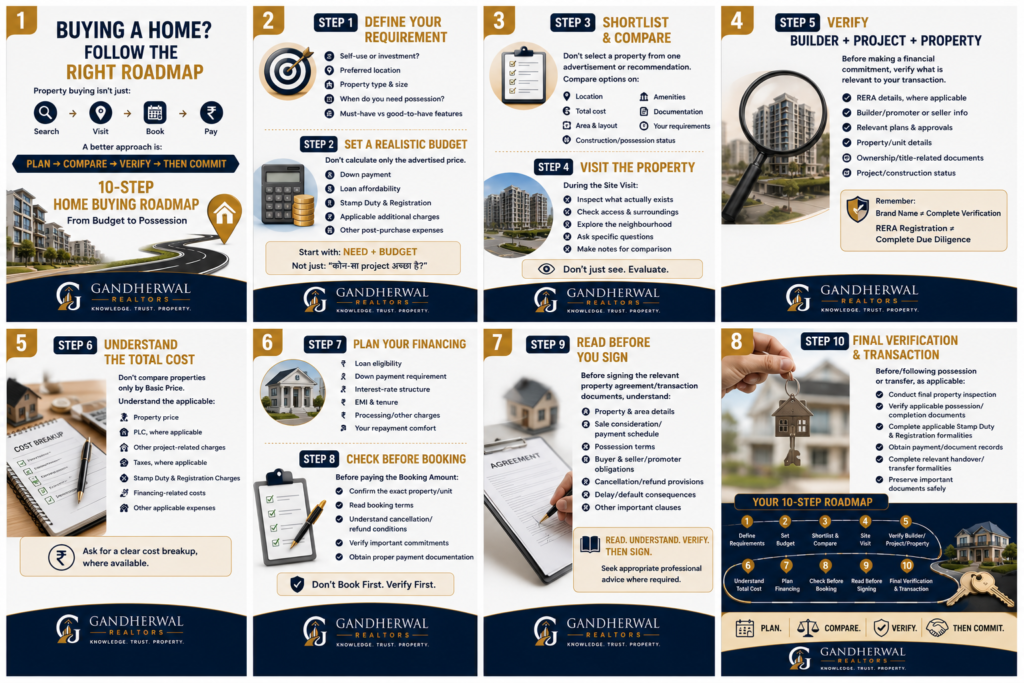
Before committing your money, you should understand your requirements, establish a realistic budget, compare properties, visit the site, verify the builder and project, understand the total cost, plan financing, review booking terms and carefully examine the relevant documents.
In simple terms:
PLAN → COMPARE → VERIFY → THEN COMMIT
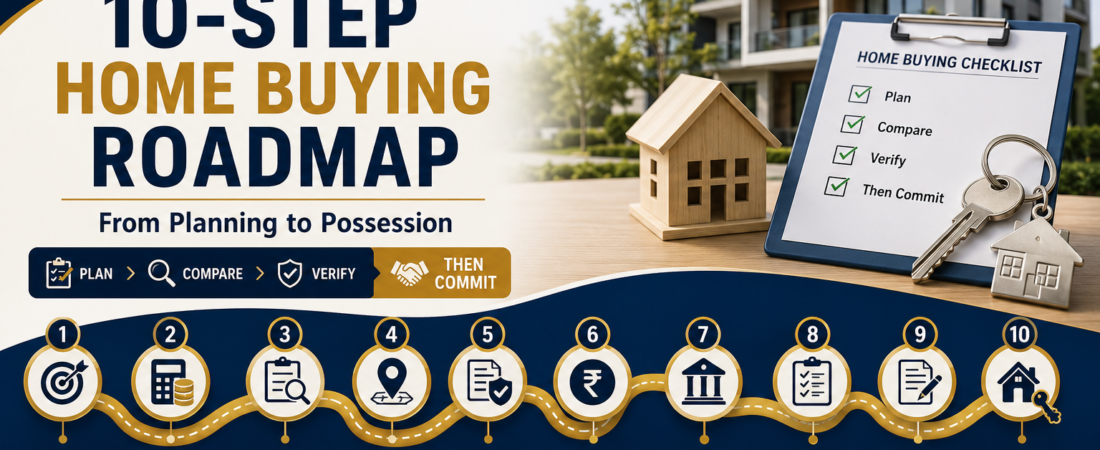
Here is a practical 10-Step Home Buying Roadmap to help you approach your property purchase more systematically.
Step 1: Define Your Home-Buying Requirements
Before searching for projects, start with yourself.
Ask:
“What exactly do I need from this property?”
Your requirements may include:
- Self-use or investment
- Preferred location
- Flat, builder floor, plot or another property type
- Number of bedrooms
- Approximate property size
- Ready-to-move or under-construction
- Desired possession timeline
- Parking requirements
- Amenities
- Connectivity
- Schools, hospitals and daily conveniences
- Long-term family requirements
Must-Have vs Good-to-Have
One useful approach is to divide your requirements into two categories.
Must-Have
These are features without which the property may not work for you.
For example:
- Maximum commuting distance
- Minimum number of bedrooms
- Required possession timeline
- Essential parking
- Budget ceiling
Good-to-Have
These may improve the property but are not necessarily essential.
For example:
- Particular view
- Club facilities
- Specific floor preference
- Additional amenities
This distinction helps prevent attractive marketing features from distracting you from your actual needs.
Start with:
NEED + BUDGET
Not simply:
“कौन-सा project अच्छा है?”
Step 2: Set a Realistic Property Budget
Once your requirements are clear, determine what you can realistically afford.
A common mistake is to treat the advertised property price as the complete cost.
It may not be.
Depending on the property and transaction, your financial commitment may involve:
- Property/basic price
- Down payment
- Preferential Location Charges (PLC), where applicable
- Other project-related charges
- Applicable taxes
- Stamp Duty
- Registration Charges
- Loan-related expenses
- Maintenance-related charges/deposits
- Interiors or furnishing
- Moving expenses
- Other applicable costs
Not every cost applies to every property, so identify what is relevant to your particular transaction.
Don’t Ask Only: “Property कितने की है?”
Also ask:
“My Total Financial Commitment कितना होगा?”
Your budget should also leave sufficient room for your other financial responsibilities rather than being based only on the maximum loan amount that may be available.
Step 3: Shortlist and Compare Properties
Once you know what you need and what you can afford, begin shortlisting properties.
Don’t choose a property based only on:
- One advertisement
- One salesperson’s recommendation
- One attractive discount
- One impressive sample flat
- One social-media video
- One friend’s opinion
Instead, compare suitable properties systematically.
Consider factors such as:
Location
How well does the location meet your daily and long-term requirements?
Total Cost
Compare the complete financial commitment rather than only the basic quoted rate.
Area and Layout
Understand relevant area measurements and whether the layout suits your requirements.
Construction/Possession Status
Is the property under construction or ready-to-move?
When do you actually need possession?
Amenities
Which amenities are available now and which are proposed or under development?
Documentation
What relevant approvals, project information and property documents are available?
Your Requirements
Most importantly:
Does the property actually solve your housing requirement?
A property can be good and still not be the right property for you.
Step 4: Conduct a Proper Site Visit
Online research can help you shortlist properties.
But a physical Site Visit can reveal things that photographs, advertisements and brochures may not fully communicate.
During the visit, check:
- Actual project/property condition
- Construction progress
- Approach road
- Entry and exit
- Surroundings
- Nearby development
- Traffic
- Noise
- Daily conveniences
- Amenities
- Common areas
- Actual unit, where available
Don’t Visit Only the Sample Flat
A sample flat is designed to help present the property attractively.
Where practical, inspect the actual unit, project, tower, plot or construction location relevant to your purchase.
Also explore the surrounding area.
Remember:
You’re buying the location too—not just the property.
If practical, visiting the location at different times can help you understand traffic, accessibility, surrounding activity and other on-ground conditions.
Site Visit Rule:
DON’T JUST SEE. EVALUATE.
Step 5: Verify the Builder, Project and Property
This is one of the most important stages of the home-buying process.
The exact verification required depends on the property and transaction.
For applicable projects, relevant checks may include:
- RERA registration/information
- Promoter/developer details
- Project status
- Relevant plans
- Applicable approvals/licences
- Declared timelines
- Property/unit details
For other transactions, verification may also involve:
- Ownership/title-related documents
- Seller details
- Encumbrance/dues-related information
- Relevant approvals
- Property-specific records
Check the Builder’s Track Record
For a developer project, look at relevant previous developments.
Consider:
- Completed projects
- Delivery history
- Construction/finish quality
- Maintenance condition
- Existing buyer/resident feedback
But remember:
Past Performance ≠ Guarantee of Future Performance
Even when you are familiar with a builder:
Evaluate the Specific Project Separately
A well-known developer can have multiple projects with different locations, approvals, specifications, timelines and development stages.
Therefore:
Builder Reputation ≠ Automatic Project Approval
And:
RERA Registration ≠ Complete Due Diligence
RERA verification, where applicable, is important—but it should form part of broader property due diligence.
Step 6: Understand the Total Cost
At this stage, you should have a much clearer understanding of the property’s complete financial picture.
Ask for a detailed cost sheet or price breakup, where available.
Depending on the transaction, review:
- Property/basic price
- Applicable area and rate
- PLC, where applicable
- Parking-related charges, where applicable
- Maintenance-related charges
- Other project-related charges
- Applicable taxes
- Stamp Duty
- Registration Charges
- Loan-related expenses
- Other applicable costs
Compare Total Cost—not Just Basic Price
Suppose:
Property A has a lower basic rate.
Property B has a slightly higher basic rate.
That alone does not establish which one represents the lower overall financial commitment.
Once applicable additional charges are considered, the comparison may change.
Therefore:
Quoted Price ≠ Necessarily Total Acquisition Cost
A written cost breakup also helps you compare multiple properties more objectively.
Step 7: Plan Your Home Loan and Financing
If you require a home loan, financing should be considered before making a major commitment, not as an afterthought.
Understand:
- Loan eligibility
- Down payment requirement
- Loan amount
- Interest-rate structure
- EMI
- Loan tenure
- Processing and other applicable charges
- Prepayment-related terms
- Your repayment capacity
EMI Affordability Matters
A lender may approve a certain loan amount, but that does not automatically mean the corresponding EMI is comfortable for your personal finances.
Consider your:
- Regular income
- Existing EMIs
- Household expenses
- Emergency needs
- Other financial goals
Your property should fit your financial life—not overwhelm it.
Fixed vs Floating Interest Rate
If evaluating loan options, understand whether the rate is fixed, floating or structured differently and how changes could affect your EMI or loan tenure.
Compare the loan terms, not just the headline interest rate.
Step 8: Check Everything Important Before Paying the Booking Amount
Once you find a suitable property, you may be asked to pay a booking amount.
This is the stage where excitement can sometimes turn into urgency.
Before paying, confirm:
Exact Property
Know precisely what unit, plot or property you are booking.
Total Cost
Understand your financial commitment beyond the booking amount.
Booking Terms
Read the applicable booking/application conditions.
Cancellation and Refund
Don’t just ask:
“Booking amount refundable है?”
Ask:
“Under what conditions?”
Understand applicable deductions and conditions.
Important Promises
If a discount, amenity, specification, possession timeline, view/facing or other commitment is influencing your decision, understand where it is appropriately recorded.
Payment Record
Verify the correct recipient/entity and obtain appropriate acknowledgement/receipt.
Remember:
DON’T BOOK FIRST. VERIFY FIRST.
Step 9: Read and Understand Before You Sign
Property agreements and transaction documents should not be treated as mere formalities.
Before signing, understand important provisions relating to:
- Property/unit details
- Area
- Sale consideration
- Payment schedule
- Possession
- Buyer obligations
- Promoter/seller obligations
- Cancellation
- Refund
- Delay/default
- Interest/penalties, where applicable
- Maintenance
- Transfer
- Dispute-related provisions
- Other relevant clauses
Don’t Depend on Verbal Assurances
If something is important enough to influence your purchase decision, understand how it is reflected in the relevant written documentation.
Remember:
VERBAL PROMISE ≠ WRITTEN COMMITMENT
And:
READ. UNDERSTAND. VERIFY. THEN SIGN.
For important legal or financial matters, seek appropriate professional advice where required.
Step 10: Final Verification, Registration and Handover
The buying process does not necessarily end when the agreement is signed.
Before completing the transaction or taking possession, as applicable, conduct the final relevant checks.
These may include:
Final Property Inspection
Inspect the actual property and note relevant issues before handover, where applicable.
Possession/Completion Documentation
Check relevant possession, completion or occupancy-related documents as applicable to the particular property.
Stamp Duty and Registration
Complete the applicable Stamp Duty and Registration formalities according to the transaction and relevant requirements.
Payment Records
Keep appropriate records of payments made.
Handover
Collect relevant documents, keys and other applicable handover materials.
Preserve Your Documents
Keep important property records safely, including relevant:
- Agreements/deeds
- Registration documents
- Payment receipts
- Loan documents
- Possession/handover records
- Applicable certificates
- Other transaction documents
These records may remain important long after the purchase is complete.
The Complete 10-Step Home Buying Roadmap
Here is the entire journey in one place:
1. Define Your Requirements
Know what you actually need.
2. Set a Realistic Budget
Understand what you can comfortably afford.
3. Shortlist & Compare
Evaluate multiple suitable options.
4. Visit the Property
Check the property and location on the ground.
5. Verify Builder + Project + Property
Conduct relevant due diligence.
6. Understand the Total Cost
Look beyond the advertised/basic price.
7. Plan Your Financing
Understand your loan and repayment commitment.
8. Check Before Booking
Review important terms before paying.
9. Read Before You Sign
Understand the relevant agreement and transaction documents.
10. Final Verification & Transaction
Complete applicable inspection, registration and handover formalities.
Common Home-Buying Mistakes to Avoid
Even with a roadmap, certain mistakes can affect the quality of a property decision.
Watch out for:
Choosing the property before establishing a budget
Know your financial boundaries first.
Falling in love with the sample flat
Evaluate the actual property/project and documentation.
Choosing only by builder reputation
Verify the specific project separately.
Looking only at the basic price
Understand the total financial commitment.
Assuming RERA registration completes all verification
Conduct broader property-specific due diligence.
Paying the booking amount under pressure
Understand the property and booking terms first.
Depending on verbal commitments
Check important representations in the relevant documentation.
Signing without understanding important clauses
Read carefully and seek appropriate advice where required.
Ignoring the surrounding location
Evaluate the neighbourhood, access and infrastructure—not just the project boundary.
A Simple Rule for Every Stage
At every stage of your home-buying journey, ask yourself three questions:
1. What am I being told?
Understand the claim or information.
2. What can I verify?
Look for relevant documents, official information and on-ground evidence.
3. How does it affect my decision?
Not every feature, risk or advantage has the same importance for every buyer.
This simple approach can help you move from being a passive property viewer to a more informed buyer.
Final Thoughts
Buying a home is not just about finding a property you like.
It is about finding a property that fits your:
Requirements + Budget + Timeline + Financial Capacity + Risk Comfort + Long-Term Plans
The process should move gradually from interest to information, information to verification, and verification to commitment.
You don’t need to know everything about real estate before buying a home.
But you should know what questions to ask, what information to verify and when to seek appropriate professional help.
So before your next property decision, remember:
PLAN. COMPARE. VERIFY. THEN COMMIT.
A good home-buying decision is not only about choosing the right property.
It is also about following the right process.
Gandherwal Realtors
Knowledge. Trust. Property.
Planning to Buy a Home?
A structured approach can make it easier to compare properties, understand costs and identify the information that requires verification before you make a financial commitment.
Gandherwal Realtors
📱 WhatsApp: +91 72064 77648
🌐 Website: gandherwalrealtors.com
Disclaimer: This article is intended for general educational purposes only and does not constitute legal, financial, investment or professional advice. Property documents, approvals, charges, taxes, financing, registration and transaction requirements vary according to the property, project, jurisdiction and transaction. Buyers should independently verify relevant information and seek appropriate professional advice where required.