When comparing properties in the same residential project, buyers sometimes notice something interesting:
Two similar units may not have the same final price.
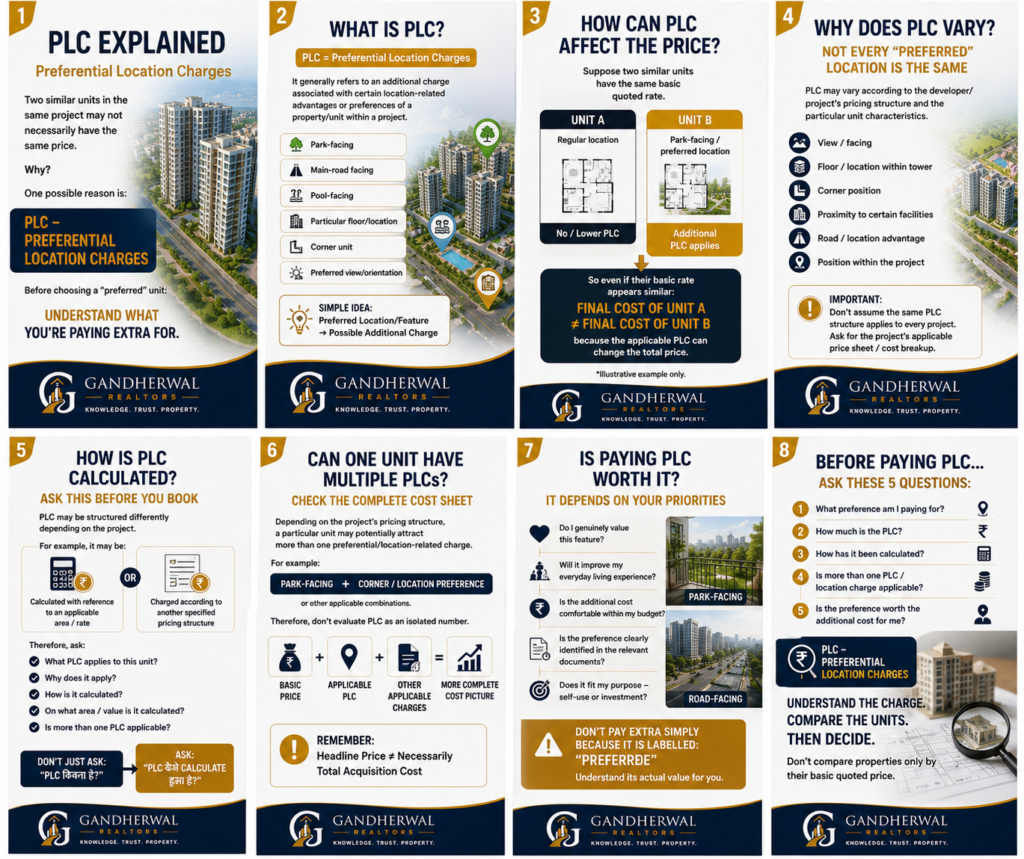
The size may be similar. The basic quoted rate may even be the same. Yet one unit can cost more than another.
One possible reason is PLC — Preferential Location Charges.
PLC can add to the overall cost of a property, so buyers should understand not only how much PLC is being charged, but also why it applies, how it has been calculated and whether the particular preference is actually worth paying extra for.
Let’s understand PLC in simple terms.
What is PLC in Real Estate?
PLC stands for Preferential Location Charges.
It generally refers to an additional charge associated with certain location-related advantages or preferences of a particular unit within a project.
For example, depending on the project, a developer’s pricing structure may differentiate units based on characteristics such as:
- Park-facing location
- Pool-facing location
- Main-road facing location
- Corner position
- Particular floor or location within a tower
- Preferred view
- Particular orientation
- Proximity to certain facilities
- Position within the project
The exact categories can differ significantly from one project to another.
In Simple Terms:
Preferred Location/Feature → Possible Additional Charge
However, buyers should not assume that every project uses the same PLC categories or calculation method.
Why Can Two Similar Units Have Different Prices?
Consider two units in the same project.
Suppose both have a similar basic quoted rate and comparable area.
Unit A
Regular location with no or lower applicable PLC
Unit B
Park-facing or another preferred location with an additional PLC
Even if the basic rate appears similar, the final financial commitment for the two units can be different.
Therefore:
Basic Price of Unit A ≈ Basic Price of Unit B
does not necessarily mean:
Final Cost of Unit A = Final Cost of Unit B
This is why buyers should compare the complete cost sheet, rather than comparing units only on their headline or basic price.
What Types of PLC May a Buyer Encounter?
PLC terminology and categories are project-specific, but some commonly encountered location-related preferences may include the following.
1. Park-Facing
A unit overlooking a landscaped park or green area may be treated as a preferred location in some projects.
For a buyer who values an open view or proximity to green space, this may be desirable.
But whether it is worth an additional cost is ultimately a buyer-specific decision.
2. Pool-Facing
In projects with swimming pools or central recreational areas, units facing these amenities may sometimes carry an additional location-related charge.
Before considering the premium, evaluate the actual view, distance, privacy and possible activity/noise around the facility.
3. Road-Facing or Location-Related Preference
A unit facing a major road or occupying a particular position in the project may have a different pricing structure.
But remember that a characteristic presented as an advantage can have both positive and negative aspects.
For example, road access may be attractive to one buyer, while another may place greater importance on noise levels or privacy.
4. Corner Unit
Some projects may treat corner units as preferable because of their position, openness, layout or other characteristics.
Again, the actual benefit should be evaluated rather than assumed.
5. Floor-Related Preference
Depending on the project and its pricing structure, particular floors or floor ranges may have different pricing or location-related premiums.
Buyers should understand exactly what charge is being applied and why rather than assuming the same structure exists across all projects.
How is PLC Calculated?
There is no single PLC calculation method that should be assumed for every property project.
Depending on the project’s pricing structure, PLC may be calculated with reference to an applicable rate and area, or it may be structured in another specified manner.
Therefore, don’t stop at asking:
“PLC कितना है?”
Ask:
“PLC कैसे calculate हुआ है?”
Important questions include:
- What PLC applies to this particular unit?
- Why does it apply?
- What is the applicable rate or amount?
- How has the amount been calculated?
- On what area or value has it been calculated?
- Is the charge one-time or structured differently?
- Is more than one preferential/location-related charge applicable?
- Where is the charge reflected in the cost sheet or relevant documents?
These questions help you understand the actual financial impact rather than seeing PLC as just another line in the price sheet.
Can More Than One PLC Apply to a Property?
Depending on the particular project’s pricing structure, a unit may potentially have more than one location-related preference or charge.
For example, a unit might be presented as having a combination such as:
Park-Facing + Corner/Location Preference
or another combination applicable to that project.
This makes it particularly important to review the complete cost breakup.
Instead of looking only at:
Basic Price
consider:
Basic Price + Applicable PLC + Other Applicable Charges = More Complete Cost Picture
The objective is to understand your overall financial commitment before booking.
PLC and Total Property Cost
One of the most common mistakes buyers can make is comparing properties only by their advertised or basic price.
Suppose a property is quoted at a certain basic rate.
Your actual acquisition cost may also involve, depending on the transaction:
- Applicable PLC
- Other project-related charges
- Maintenance-related charges/deposits
- Parking-related charges, where applicable
- Applicable taxes
- Stamp Duty
- Registration Charges
- Other transaction-related costs
Not every charge applies to every transaction.
The important principle is:
Headline Price ≠ Necessarily Total Acquisition Cost
Ask for a detailed cost sheet and understand each applicable component before comparing properties.
Is Paying PLC Worth It?
This is perhaps the most important question.
And there is no universal Yes or No.
A preferred location may provide substantial value to one buyer and very little value to another.
Before paying additional PLC, consider the following.
Do You Actually Value the Feature?
Suppose you are being offered a park-facing unit at an additional cost.
Ask yourself:
Would I personally value that view or location enough to pay the premium?
If the answer is no, the word “preferred” should not by itself persuade you to spend more.
Will It Improve Your Living Experience?
For a self-use buyer, factors such as view, sunlight, privacy, noise, access and surroundings may influence everyday living.
Evaluate the actual unit position rather than simply relying on the label attached to it.
Is the Additional Cost Comfortable Within Your Budget?
A preference can be desirable without being financially sensible for a particular buyer.
Compare the incremental cost with your overall property budget and other priorities.
Is the Preference Clearly Identified?
If you are paying an additional amount for a particular location or feature, understand how that preference is reflected in the cost sheet, unit details and relevant transaction documents, as applicable.
Does It Match Your Purpose?
A self-use buyer and an investment-oriented buyer may evaluate the same preference differently.
A self-use buyer might value a particular view or location because of personal lifestyle preferences.
An investor may focus more on the overall acquisition cost, demand, marketability and other property-specific considerations.
Neither approach is automatically right or wrong.
Don’t Assume “Preferred” Means Better
This is an important principle.
Preferred ≠ Better for Every Buyer
For example:
A road-facing unit may appeal to someone because of accessibility or openness.
Another buyer may prefer an internal location because of privacy or lower road noise.
Similarly, a unit near an amenity may be convenient for one family but less attractive to someone seeking a quieter location.
Therefore, don’t pay extra simply because a unit has been labelled “premium,” “preferred,” “park-facing,” “corner,” or another attractive term.
Understand the actual characteristic and decide whether it creates meaningful value for you.
How to Compare Two Units With Different PLCs
If you are choosing between two units in the same project, create a simple comparison.
| Factor | Unit A | Unit B |
|---|---|---|
| Basic Price | Check | Check |
| Area | Check | Check |
| Location within Project | Check | Check |
| View/Facing | Check | Check |
| Applicable PLC | Check | Check |
| Other Applicable Charges | Check | Check |
| Total Financial Commitment | Compare | Compare |
| Personal Preference | Evaluate | Evaluate |
This can reveal whether the additional premium is justified for your requirements.
Sometimes the more expensive unit may genuinely offer a feature you highly value.
In another case, you may find that a less expensive unit meets your needs equally well.
5 Questions to Ask Before Paying PLC
Before booking a unit with an additional location-related charge, ask:
1. What preference am I paying for?
Identify the exact characteristic attracting the charge.
2. How much PLC is applicable?
Don’t rely on a general project-level estimate. Understand the amount applicable to the specific unit.
3. How has the PLC been calculated?
Understand the rate, area/value or other calculation basis used.
4. Is more than one PLC or location-related charge applicable?
Check the complete cost sheet for all relevant components.
5. Is the preference worth the additional cost for me?
This is ultimately the buyer’s decision.
Don’t allow the word “preferred” to make that decision for you.
Buyer Checklist Before Booking
Before finalising a property, consider verifying:
☐ Exact unit being offered
☐ Area details
☐ Basic property price
☐ Applicable PLC
☐ Reason for the PLC
☐ PLC calculation method
☐ Area/value used for calculation
☐ Multiple PLCs/location charges, if applicable
☐ Other applicable charges
☐ Complete cost sheet
☐ Relevant project/unit documents
☐ Whether the preference genuinely suits your requirements
Keeping these points together makes it easier to compare different units objectively.
Final Thoughts
PLC should not automatically be viewed as either good or bad.
The important question is whether you understand what you’re paying for.
Before choosing a preferred unit:
**Understand the Charge.
Compare the Units.
Evaluate the Value.
Then Decide.**
Don’t compare properties only on their basic quoted prices.
And don’t pay an additional premium merely because something has been labelled “preferred.”
A better property decision comes from understanding the complete cost and the actual value the property provides to you.
Gandherwal Realtors
Knowledge. Trust. Property.
Need Help Understanding a Property Cost Sheet?
Property pricing can include several components beyond the basic quoted price.
Understanding the complete cost structure can help you compare properties and units more effectively before making a decision.
Gandherwal Realtors
📱 WhatsApp: +91 72064 77648
🌐 Website: gandherwalrealtors.com
Disclaimer: This article is intended for general educational purposes only and does not constitute legal, financial or professional advice. PLC terminology, applicability, calculation methods and other charges may vary by developer, project, property and transaction. Buyers should verify the applicable cost sheet, agreement and relevant documents and seek appropriate professional advice where required.