
When buying a completed property, most buyers naturally focus on the location, price, size, amenities and construction quality.
However, a property’s documentation can be just as important as the property itself.
Two terms that property buyers frequently come across are:
Occupancy Certificate (OC) and Completion Certificate (CC).
Although these certificates are related to the completion and occupation of a building, they are not the same thing.
Understanding the difference between OC and CC can help buyers conduct better property due diligence and ask the right questions before making a major financial commitment.
What is a Completion Certificate (CC)?
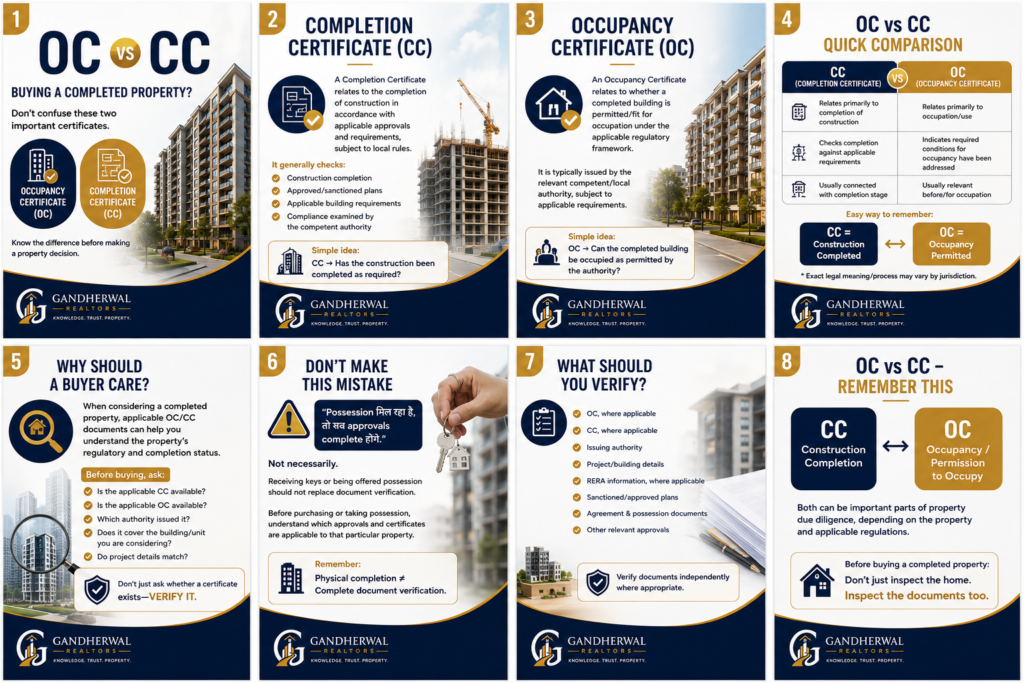
A Completion Certificate (CC) generally relates to the completion of construction in accordance with the applicable sanctioned plans, approvals and building requirements.
Depending on the applicable local rules and competent authority, the completion process may involve examination of matters such as:
- Completion of construction
- Compliance with sanctioned or approved plans
- Applicable building regulations
- Required specifications or conditions
- Other requirements prescribed by the competent authority
In simple terms:
CC = Construction Completion
It essentially relates to whether the construction has been completed in accordance with the applicable requirements.
However, the exact procedure, terminology and requirements can differ depending on the jurisdiction and type of property.
What is an Occupancy Certificate (OC)?
An Occupancy Certificate (OC) generally relates to whether a completed building is permitted or considered fit for occupation under the applicable regulatory framework.
It is typically issued by the relevant competent or local authority after the applicable requirements have been satisfied.
In simple terms:
OC = Occupancy / Permission to Occupy
Therefore, while CC primarily relates to completion of construction, OC primarily relates to occupation or use of the completed building, subject to the applicable rules.
OC vs CC: What is the Difference?
The easiest way to understand the distinction is:
| Completion Certificate (CC) | Occupancy Certificate (OC) |
|---|---|
| Relates primarily to completion of construction | Relates primarily to occupation/use |
| Connected with applicable construction requirements | Connected with applicable requirements for occupancy |
| Generally associated with the completion stage | Generally relevant to occupation of the completed building |
| CC = Construction Completion | OC = Occupancy / Permission to Occupy |
This is a simplified explanation for buyers.
The exact legal meaning, process, applicability and sequence of these certificates may vary according to state laws, local regulations, competent authority and property type.
Why Are OC and CC Important for Property Buyers?
Suppose you visit a residential project and find that:
- The building looks complete
- Roads and landscaping are ready
- Flats are finished
- Families have started moving in
- The developer or seller is offering possession
It can be tempting to assume that all the necessary approvals and documentation must therefore be complete.
That assumption should be avoided.
Physical completion is not the same as complete document verification.
Where OC and/or CC are applicable, checking their status can help a buyer better understand the regulatory and completion status of the property.
A Common Mistake Buyers Make
One common assumption is:
“Possession मिल रहा है, तो सभी approvals complete होंगे.”
Not necessarily.
Getting the keys, seeing other residents living in the project or receiving an offer of possession should not replace proper verification of applicable documents.
A buyer should understand:
- Which certificates are applicable?
- Have they been issued?
- Who issued them?
- Which building or portion of the project do they cover?
- Do the details correspond to the property being purchased?
These questions are more useful than simply asking:
“OC/CC है?”
What Should You Check in an OC or CC?
Simply seeing a document titled “Occupancy Certificate” or “Completion Certificate” may not be sufficient.
Where applicable, consider verifying:
1. Issuing Authority
Check which competent authority has issued the certificate.
2. Project Details
Verify the project name, location and other identifying details mentioned in the document.
3. Building or Tower Details
In a large project, understand whether the document relates to the specific building, tower, phase or portion relevant to your proposed purchase.
4. Date of Issue
Check when the certificate was issued and whether it corresponds with the relevant stage of the development.
5. Conditions, If Any
Read the document rather than looking only at its heading. Understand whether any conditions or qualifications are mentioned.
6. Supporting Project Documents
Where appropriate, compare the information with other relevant project records and approvals.
What Else Should You Verify Before Buying a Completed Property?
OC and CC are important, but they should not be treated as the complete property-verification process.
Depending on the property and transaction, buyers may also need to examine:
✔ Ownership and Title
Understand who legally owns the property and whether the seller has the right to transfer it.
✔ RERA Information
For projects to which RERA registration requirements apply, verify the relevant project information on the appropriate RERA portal.
✔ Sanctioned/Approved Plans
Check relevant sanctioned plans and approvals, where applicable.
✔ Encumbrances and Financial Dues
Understand whether there are mortgages, charges, maintenance dues, property tax dues or other relevant liabilities.
✔ Agreement and Possession Documents
Read the relevant agreement and possession-related documents carefully.
✔ Physical Property
Compare the actual property with the documents, specifications and representations provided to you.
OC and CC Are Part of a Bigger Due-Diligence Process
A useful way for a buyer to think about property verification is:
Title + Ownership + Approvals + RERA + OC/CC + Agreement + Financial Dues + Physical Verification
No single document should automatically be treated as proof that every aspect of a property transaction has been verified.
For example, the availability of an OC or CC does not eliminate the need to examine ownership, title, agreement terms or other relevant documents.
Similarly, RERA registration should not replace complete property due diligence.
Each check answers a different question.
Simple Buyer Checklist
Before buying a completed property, consider asking:
☐ Is an OC applicable, and is it available?
☐ Is a CC applicable, and is it available?
☐ Which authority issued the documents?
☐ Do they cover the relevant project/building/phase?
☐ Have I checked the relevant RERA information?
☐ Have I examined sanctioned/approved plans where applicable?
☐ Have I checked ownership and title documents?
☐ Have I understood the agreement and possession documents?
☐ Have I checked relevant financial dues or encumbrances?
☐ Have I physically inspected the property?
☐ Have I sought appropriate professional advice where required?
If important questions remain unanswered, it may be sensible to complete the verification before making a major financial commitment.
Final Thoughts
The difference between OC and CC can be remembered very simply:
🏗️ CC = Construction Completion
🏠 OC = Occupancy / Permission to Occupy
But for a property buyer, the bigger lesson is more important.
A completed-looking building should not automatically be treated as a completely verified property.
Before purchasing, understand which documents and approvals are applicable to that particular property and verify them carefully.
Don’t just inspect the home. Inspect the documents too.
Better property decisions begin with better property knowledge.
Gandherwal Realtors
Knowledge. Trust. Property.
Need Help With Your Property Decision?
Whether you are considering a flat, builder floor, plot or another residential property, proper evaluation and document awareness can help you make a more informed decision.
Gandherwal Realtors
📱 WhatsApp: +91 72064 77648
🌐 Website: gandherwalrealtors.com
Disclaimer: This article is intended for general educational purposes only and should not be treated as legal, financial or professional advice. Requirements relating to Occupancy Certificates, Completion Certificates and other property approvals can vary according to jurisdiction, property type and applicable regulations. Buyers should independently verify relevant documents and obtain appropriate professional advice before proceeding with a property transaction.